eu cleantech
quarterly briefing
Download the printable version
1q26

Welcome to Your Q1 2026 Briefing

VICTOR VAN HOORN
Director
As we close the first quarter of 2026, Europe is once again reminded that geopolitics, economic prosperity and energy policy are inseparable. The war in the Middle East has sent fresh shockwaves through global oil and gas markets and disrupted less known but fundamental supply chains such as urea for fertilizer, sulfur and helium. But the lesson is unmistakable: on April 23, the EU had spent an estimated EUR 24 billion more on fossil fuels. As European governments seek to shield their citizens and businesses from these shocks, these measures are increasingly less fiscally sustainable: every Euro spent on fossil fuel support is one that cannot be spent on education, innovation, defense. Therefore, electrification - through renewables, storage and flexibility, stronger grids - are not only climate solutions, but they are also the backbone of the future European energy security and necessary. More than ever, the business case for cleantech is a business case for resilience.

Against this backdrop, global cleantech investment has suffered from mounting macroeconomic headwinds: deep geopolitical uncertainty, the surge in fossil fuel and transport costs triggered by the Iran war, persistent inflation and a higher interest rate environment weighing on capital deployment. EU cleantech venture and growth investment fell to €1.3 billion in Q1 2026, down from €2 billion in Q4 2025 and well below the 2024 quarterly average of €2.2 billion. Total deal volume dropped to 62, the lowest quarterly count since 2017, with late-stage activity contracting to just 15 Series B and growth equity deals. The slowdown is even sharper in the United States, where €3.5 billion was raised across only 72 deals – the lowest since at least 2014 – with capital concentrated in a handful of nuclear and energy storage megadeals. EU investment has also become heavily concentrated in the Energy & Power sector. On the debt side, EU cleantech debt funding held up better at €2.3 billion across 8 deals, overtaking the US for the first time in recent memory as US debt collapsed to €2 billion amid tightening credit and rising private-credit default fears. Capital is also rotating toward technologies that decentralise resource systems and localise supply chains – long-duration storage, BESS, recycling, geothermal – while ESG-led segments like carbon removals lose momentum.

The structural weakness, however, is unmistakable: a persistent late-stage equity gap is preventing European scaleups from reaching commercial maturity and unlocking the larger debt rounds that follow. The EIB Group's launch of ETCI 2.0, targeting €15 billion to back around 100 European growth funds, and the upcoming Scaleup Europe Fund are welcome responses, but they must be deployed at speed and complemented by stronger institutional investor allocation to scale up capital.

On the demand side, the Industrial Accelerator Act (IAA) was meant to be the starting gun for a more assertive 'Made in Europe' industrial policy. But the final proposal is significantly weaker than earlier drafts: a narrower scope of local content requirements, generous escape clauses and an overly broad definition of "Union-origin" dilute the demand signal. China's late-April announcement threatening countermeasures against European trade defence tools, combined with its continued restrictions on critical raw material exports, makes it clear that timidity is no longer an option. Co-legislators must tighten the geographic scope to the EU/EEA with possibility of building partnerships with 'middle powers', close value chain gaps in batteries, grids and electrolysers, and build credible lead markets. Otherwise, they risk missing the reindustrialisation trajectory the IAA was designed to trigger.

The EU has responded rapidly to the energy shock. On 22 April 2026, the Commission unveiled AccelerateEU, addressing Europe's stark exposure (€340 billion in fossil fuel imports in 2025, plus €24 billion since March) with electrification at its core. The Grids Package, Electrification Action Plan and Geothermal Action Plan will be decisive to expand grid capacity, restore the investment case for renewables and flexibility, and unlock baseload capacity. Grid resilience is now a security imperative as much as an investment case: Ukraine has shown how exposed European infrastructure is to drones and sabotage, pulling intrusion-detection and grid protection into cleantech-core. Geothermal, in particular, must move beyond niche status: next-generation systems alone could generate 301 TWh annually in the EU – 42% of coal- and gas-fired generation – as domestic, attack-resilient firm power. And additional baseload has a systems value: it reduces the overall forecasted grids buildout.

These short-term measures will only be viable if the long-term direction holds. The crisis has prompted pushback from a few Member States on the EU Emissions Trading System trajectory. While the pressure is understandable, it must not derail the cornerstone of European climate policy. The ETS remains the most important driver of the cleantech business case in Europe; its predictability is what allows AccelerateEU's short-term tools to land. The two work in tandem, not in opposition. But it's vital that AccelerateEU is not limited to an 'electrification target' but focusses on a very accurate diagnosis of investment bottlenecks and has a concrete strategy to unlock these and unlock the necessary enabling measures.

Finally, we had the pleasure of hosting with the Cleantech Friendship Group the IEA to present its Energy Technology Perspectives in Brussels. What came out of it is an uncomfortable fact the EU will need to address head on: energy security dictates the EU moves fast on electrification. But any electrification scenario will, in the absence of industrial policy step change, grow the EU's technological dependency on China. The EU has a very careful balancing act to perform: reduce a dependence on imported fossil fuels without sleepwalking into a dependency on imported technology.
Executive Summary

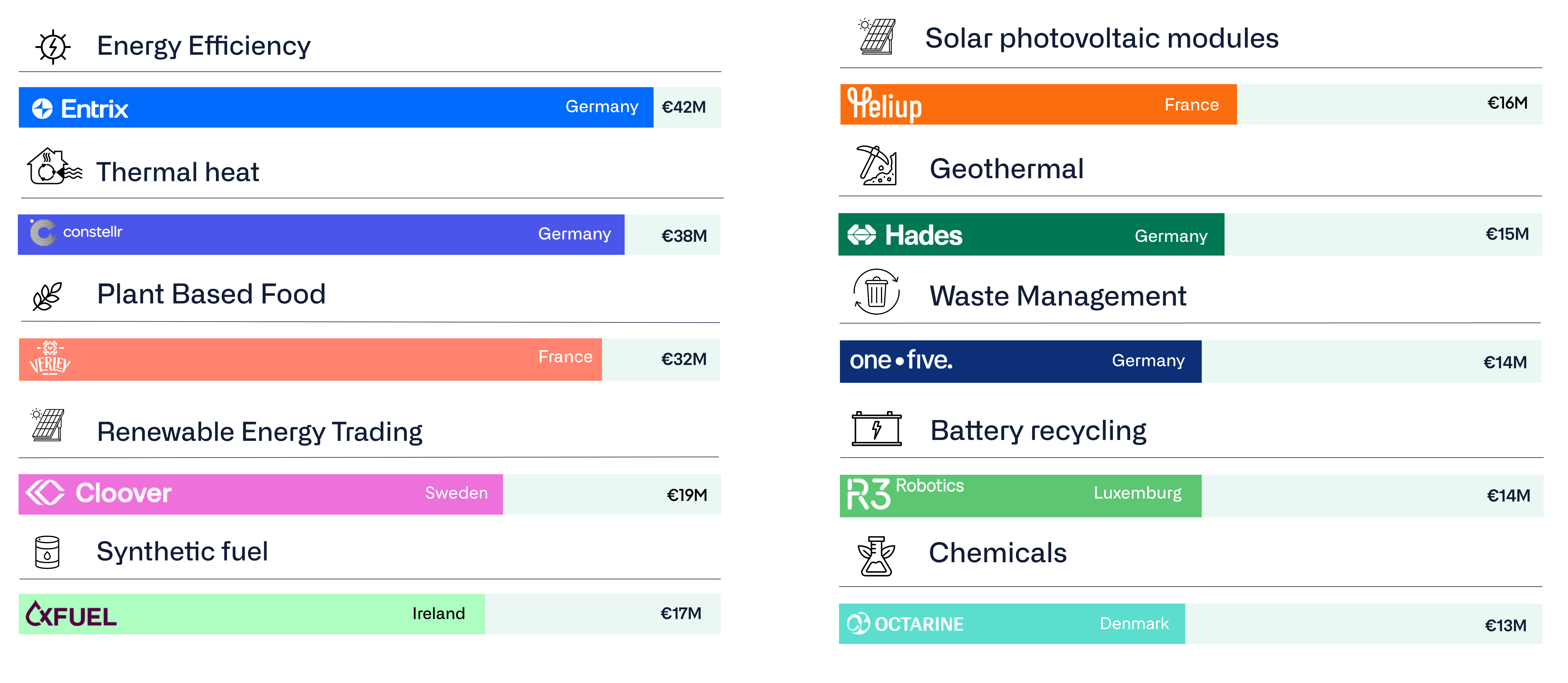
EU cleantech venture and growth investment fell to €1.3 billion in Q1 2026, down by €700 million from the previous quarter.
US investment also fell to €3.5 billion and deal volume dropped to 72 deals, the lowest since at least 2014, highlighting the ongoing consolidation of the market
Average EU deal size was €20 million, down from €24 million in Q4 2025.
EU Total deal in volume dropped from 85 to 62 deals, hitting once again an 8-year low.
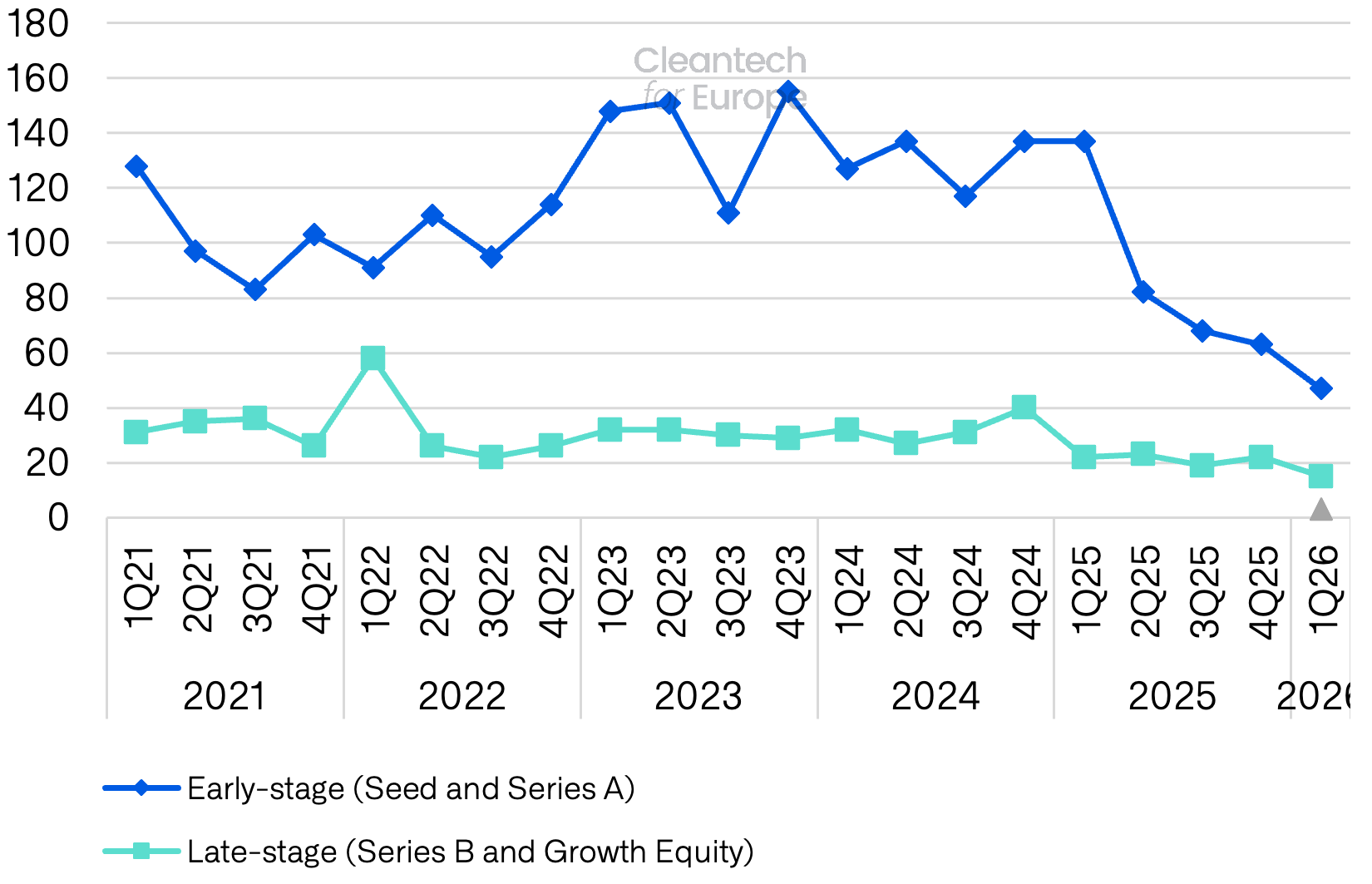
Early-stage deal volume (seed and Series A) fell by 25%, from 63 to 47 deals.
Late-stage deal volume (Series B and growth equity) dropped slightly, from 22 to 15 deals, marking the lowest amount in over 5 years.
Cleantech VC deals took place in 16 out of 27 EU member states in Q1 2026. Germany kept its leading position with 18 deals, followed by France (12), the Netherlands (7), Spain (6), Austria (4), and Sweden (3).
EU cleantech debt investment accounts for €2.3 billion in Q1 2026, slightly down from €2.6 billion in the last quarter.
8 debt deals were recorded in Europe, down from 9 in Q4 last year.
EU debt volumes overtook the US this quarter for the first time in recent memory, as US cleantech debt investment collapsed to just €2 billion across 10 deals.
To meet its clean industrial ambitions, the EU faces a strong need for measures capable of unlocking growth-stage debt at scale. Scale-up equity is then even more vital as it unlocks the debt market.
Amid mounting pressure to reindustrialise Europe, the Commission unveiled the IAA on 4 March, introducing Union-origin criteria for clean tech.
As competitiveness concerns grow, the Commission will review the ETS by July 2026, prompting Cleantech for Europe to mobilise signatories in its defence.
To tackle Europe's fragmented business environment, the Commission presented on 18 March an optional EU-wide corporate framework and scaleup definitions.
Facing €340 billion in 2025 fossil fuel imports and Middle East volatility, the Commission unveiled AccelerateEU on 22 April, a five-pillar energy strategy.
Addressing Europe's structural late-stage equity gap, the EIB launched ETCI 2.0 targeting €15 billion, complemented by the upcoming Scaleup Europe Fund.

01

Q1 2026: Continued decline in investment activity

1.3
billion

INVESTED IN EU CLEANTECH IN Q1 2026

Amount invested decreased and deal volume fell to 8-year low

EU Investment Retreats,
US Contracts More Steeply

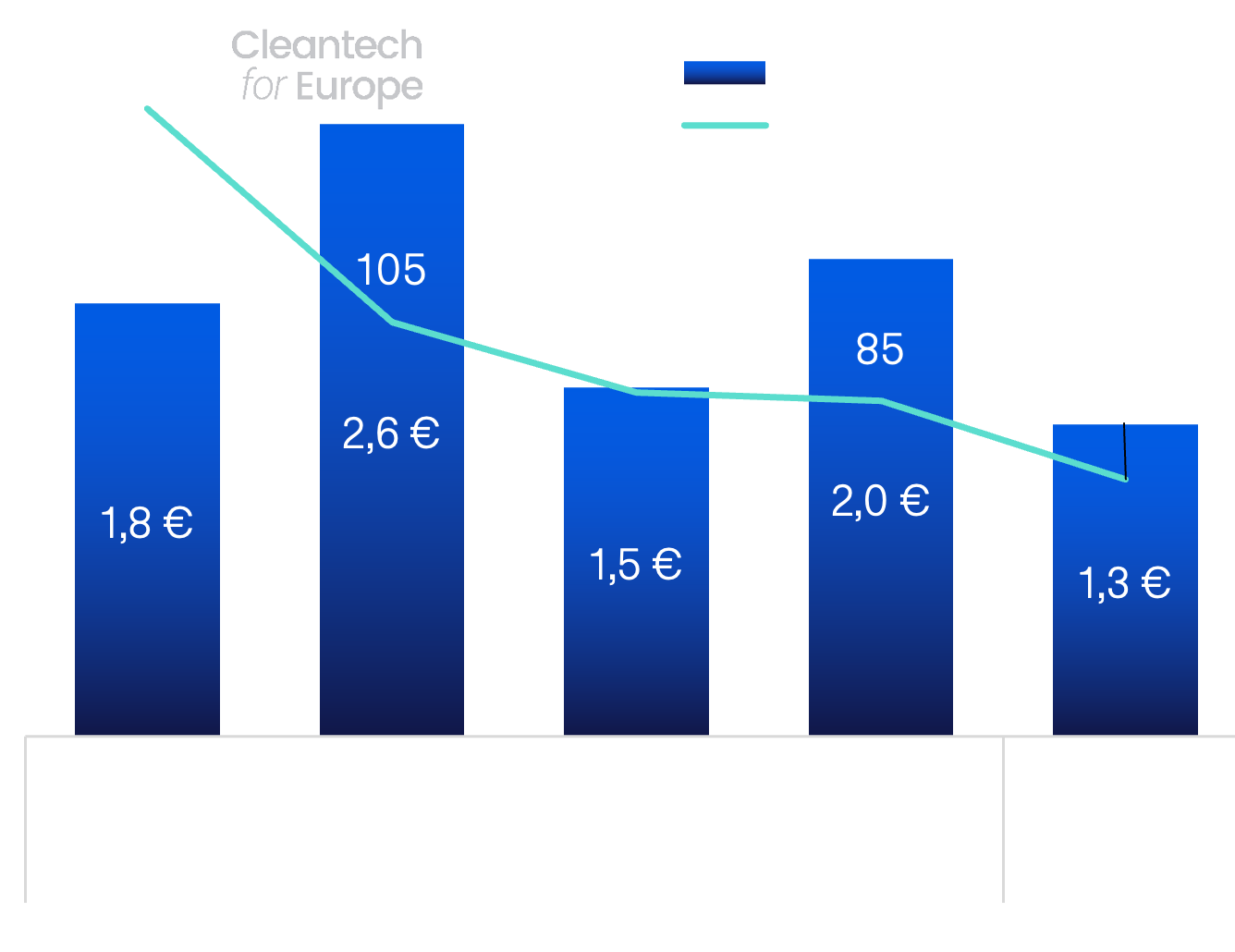
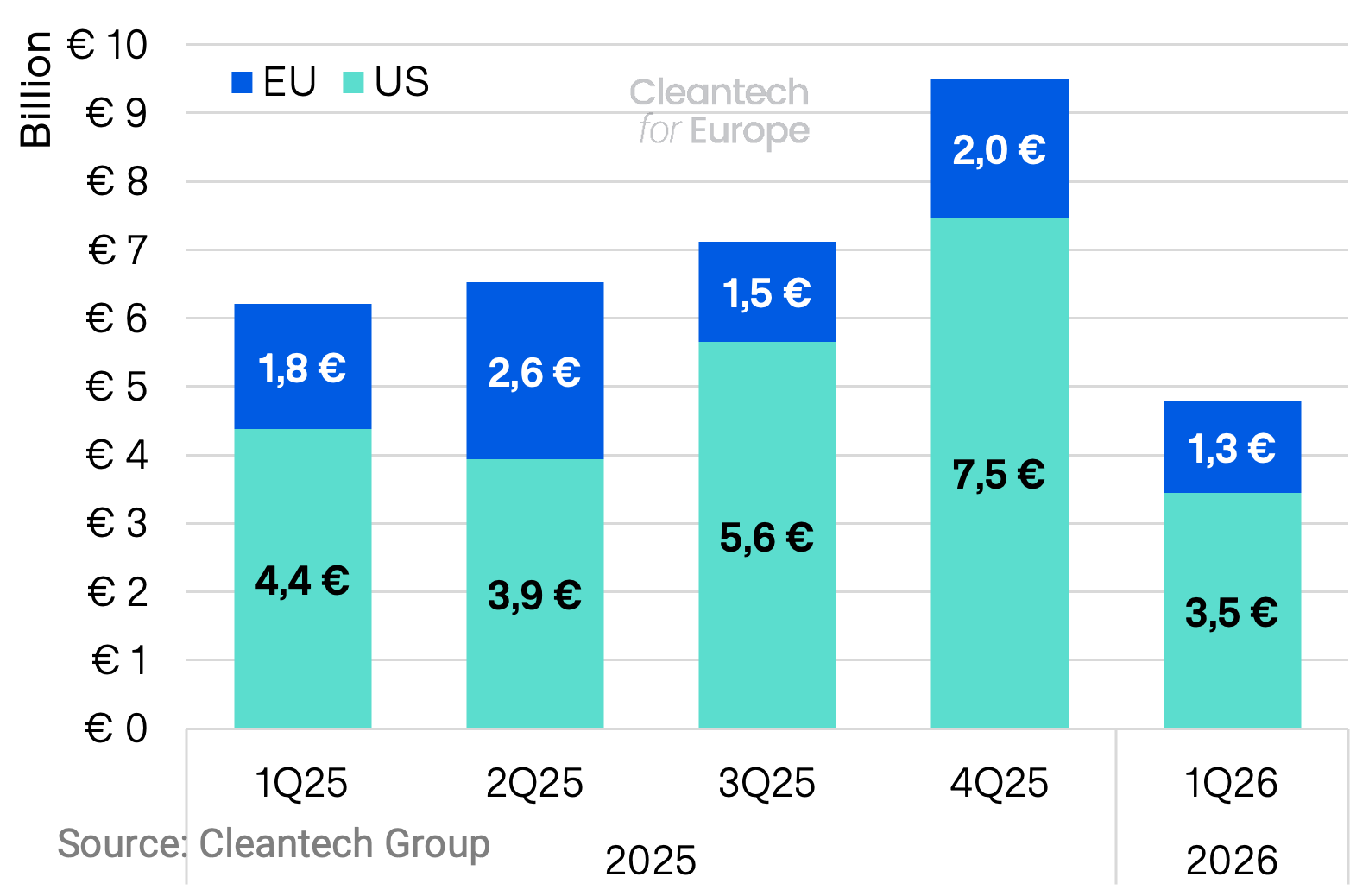
EU cleantech venture and growth investment fell to €1.3 billion in Q1 2026, down from €2 billion in Q4 2025 and well below the 2024 quarterly average of €2.2 billion. Total EU deal volume declined to 62 deals, continuing its downward trajectory from 85 in both Q4 and Q3 2025 and 105 in Q2, and marking the lowest quarterly deal count since 2017.
The decline is more pronounced in the United States, which ended 2025 with €7.5 billion raised in Q4, and saw only €3.5 billion in Q1 2026 – the lowest level since Q3 2024. This slowdown is also evident in the deal volume, which fell further this quarter to 72, the lowest since at least 2014. The topline figure is attributable to a handful of megadeals, particularly in the fields of nuclear fusion (Inertia and Shine Technologies) and energy storage (Enervenue and Lunar Energy), which still reflects the more concentrated nature of US investment.
By contrast, EU investment is more distributed across sectors and companies, reflecting Europe’s more advanced clean industrial transformation and steadier regulatory environment, in contrast with US stop-and-go policy dynamics.
Early-stage activity in Europe continued to fall sharply, with 47 deals in Q1 (down from 63 in Q4 2025 and 68 in Q3). Late-stage investment also weakened slightly, with only 15 Series B and growth equity deals, down from an average of 20 deals per quarter in 2025. As a result, average deal size fell to €20 million, down from €24 million in Q4 last year.
Cleantech Venture and Growth Investment, EU vs US, 2025 – Q1 2026
EU27 Cleantech Venture and Growth deals by stage, 2021 – Q1 2026

Q3 Deal distribution:
geography & sectors

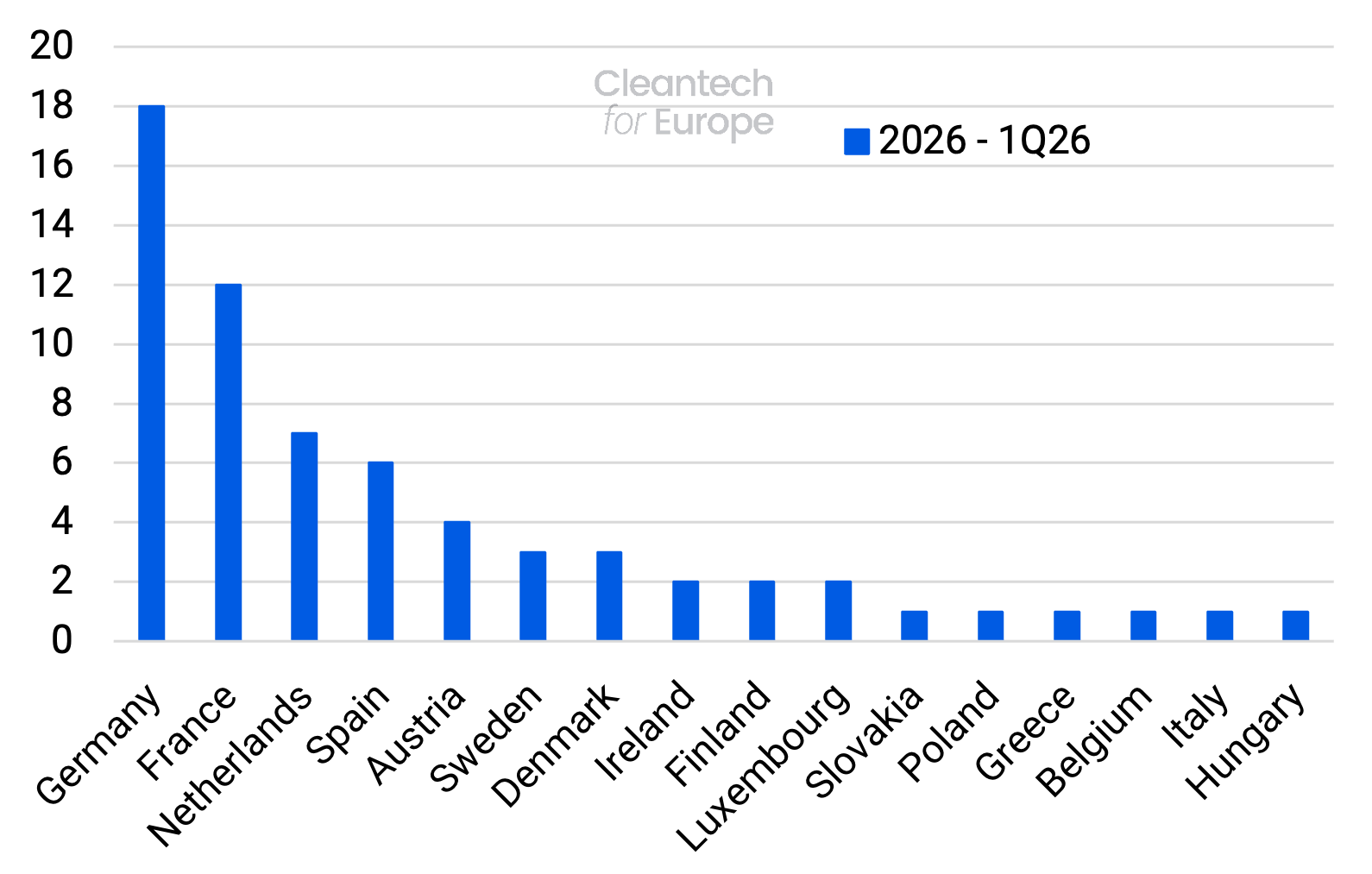
Cleantech VC deals took place in 16 out of 27 EU member states in Q1 2026.
Germany remained in the lead with 18 deals, followed by France (12), the Netherlands (7), Spain (6), Austria (4), and Sweden (3).
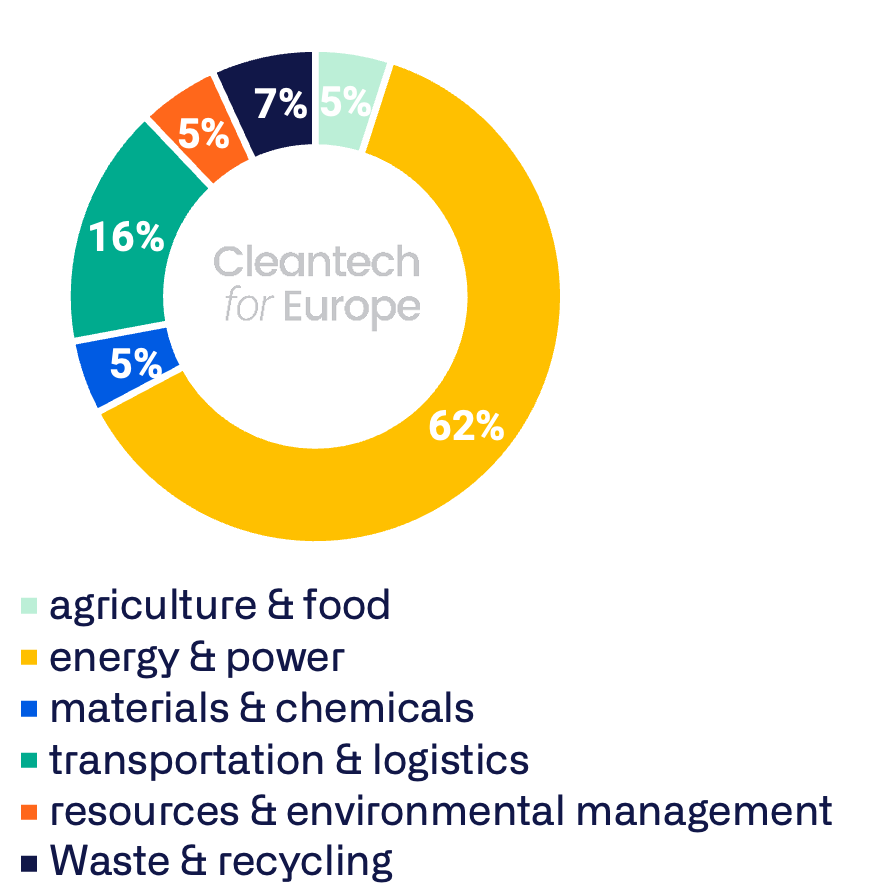
Energy & Power retained its position as the dominant sector, accounting for 62% of all Q1 venture and growth investment.
It was followed, far behind, by Transportation & Logistics (16%), Waste & Recycling (7%), and, on a par, Resources & Environmental Management (5%), Agriculture & Food (5%), and Materials & Chemicals (5%).
This distribution underscores the concentration of capital in electrification and key industrial decarbonisation technologies. Electrification, being more energy-efficient, is being prioritised at a time when energy security is of paramount importance. There is a very strong business case for technologies that mitigate energy prices volatility and optimise power flexibility.
The sectoral concentration highlights growing interest in grids, electrification, and industrial decarbonisation, while the geographical concentration points to untapped potential across the continent. Upcoming EU initiatives such as the Grids Package, the Electrification Action Plan, the Geothermal Action Plan, and the Industrial Accelerator Act, alongside active Member State implementation, will be key to unlocking this potential.
EU cleantech venture and growth deals by member state, Q1 2026
EU cleantech venture and growth investment by sector, Q1 2026
Q12024_early_Sensors
Sensors
France
€15M
€15M
Q12024_early_Alternativeproteins
Alternative proteins-Q124
Germany
€15M
€15M
Q12024_early_wastemanagementq124
Waste management-q124
France
€21M
€21M
Q12024_early_industrialmaterials
Industrial Materials
France
€23M
€23M
Q12024_early_carbonremovals
Carbon Removals
Germany
€25M
€25M
Q12024_early_energystorage
Energy Storage
Finland
€26M
€26M
Netherlands
€15M
€15M
Q12024_early_transportation
Transportation
Croatia
€99M
€99M
Austria
€20M
€20M
Italy
€15M
€15M
AB2023_early_Construction
Construction
Germany
€45M
€45M
AB2023_early_Hydrogen Fuel Cells
Hydrogen Fuel Cells
France
€46M
€46M
AB2023_early_Nuclear fission
Nuclear fission
France
€50M
€50M
AB2023_early_Supply chain Logistics
Supply chain & Logistics
Germany
€50M
€50M
AB2023_early_EV Charging
EV Charging
Germany
€70M
€70M
AB2023_early_Heat pumps
Heat pumps
Sweden
€86M
€86M
AB2023_early_Carbon Management
Carbon Management
Germany
€100M
€100M
AB2023_early_Green IT
Green IT
France
€100M
€100M
France
€90M
€90M
AB2023_early_Electric Vehicles
Electric Vehicles
France
200M
200M
3Q23__Others__Logistics
Transportation & Logistics
Germany
€177M
€177M
3Q23__Others__Hydro
Green Hydrogen
Germany
€169
€169
Netherlands
€130M
€130M
3Q23__Others__CRM
Critical Raw Materials
Ireland
€184
€184
3Q23__Others__Plastic
Plastic Alternatives
Netherlands
€338M
€338M
Germany
€130M
€130M
3Q23__Others__Energy
Energy & Power
Germany
€685M
€685M
3Q23__Others__EV
EV Batteries
Sweden
1100M
1100M
France
€650
€650
France
€600M
€600M
3Q23__Late__Energy
Energy & Power
Sweden
€45M
€45M
3Q23__Late__Hydro
Green Hydrogen
Portugal
€61M
€61M
3Q23__Late__Agri
Agriculture & Food
Belgium
€72M
€72M
Netherlands
€32M
€32M
3Q23__Late__Solar
Solar
Lithuania
€93M
€93M
3Q23__Late__Construction
Buildings & Construction
France
€106M
€106M
Ireland
€26M
€26M
Netherlands
€25M
€25M
3Q23__Late__EV
EV Batteries
France
€850M
€850M
3Q23__Late__Steel
Green Steel
Sweden
€1500M
€1500M
3Q23__Early__Geo
Geospatial Imagery
Germany
€17M
€17M
3Q23__Early__Transportation
Transportation & Logistics
Germany
€18M
€18M
Spain
€16M
€16M
3Q23__Early__Quantum
Quantum Computing
France
€19M
€19M
3Q23__Early__Energy
Energy & Power
Germany
€25M
€25M
3Q23__Early__Agriculture
Agriculture & Food
Denmark
€30M
€30M
3Q23__Early__Plastic
Plastic Alternatives
Germany
€36M
€36M
Finland
€23M
€23M
3Q23__Early__Construction
Buildings & Construction
Germany
€45M
€45M
Germany
€22M
€22M
2Q23__Late__Carbon
Carbon Management
Luxembourg
€34M
€34M
2Q23__Late__Agri
Agriculture
France
€162
€162
2Q23__Late__EV
EV Charging
France
€252M
€252M
Germany
€153M
€153M
Finland
€66M
€66M
Ireland
€57M
€57M
2Q23__Late_Energy
Energy, Energy Storage & Networks
Germany
€433
€433
Germany
€370M
€370M
Sweden
€90M
€90M
Italy
€41M
€41M
2Q23__Early__Electro
Electronic Devices
Germany
€20M
€20M
2Q23__Early__Biotech
Biotechnology
Germany
€20M
€20M
2Q23__Early__Construction
Buildings, Building Materials & Construction
France
€29M
€29M
France
€20M
€20M
2Q23__Early__Logistics
Transportation, Supply Chain & Logistics
Germany
€41M
€41M
Germany
€29M
€29M
France
€21M
€21M
Austria
€18M
€18M
2Q23__Early__Green-IT
Green IT
France
€91M
€91M
2023-Q1-chart__series-B__geo
Geothermal
France
€45M
€45M
2023-Q1-chart__series-B__waste
Waste Management
Netherlands
€50M
€50M
2023-Q1-chart__series-B__agrifood
Agriculture & Food
Denmark
€65M
€65M
Denmark
€47M
€47M
2023-Q1-chart__series-B__buildings
Buildings & Construction
Austria
€93M
€93M
Germany
€44M
€44M
2023-Q1-chart__series-B__blockchain
Blockchain
No items found.
2023-Q1-chart__series-B__solar
Solar
Germany
€215M
€215M
Italy
€117M
€117M
Sweden
€29M
€29M
2023-Q1-chart__series-A__solar
Solar
Ireland
€15M
€15M
2023-Q1-chart__series-A__heatpumps
Heat Pumps
Netherlands
€15M
€15M
2023-Q1-chart__series-A__fusion
Nuclear Fusion
France
€15M
€15M
2023-Q1-chart__series-A__energy
Energy & Power
Slovakia
€16M
€16M
2023-Q1-chart__series-A__agrifood
Agriculture & Food
Netherlands
€21M
€21M
2023-Q1-chart__series-A__geospatial
Geospatial imagery
Latvia
€28M
€28M
2023-Q1-chart__series-A__transportation
Transportation and Logistics
Germany
€42M
€42M
France
€21M
€21M
Germany
€15M
€15M
2023-Q1-chart__series-A__buildings
Buildings
Sweden
€42M
€42M
2023-Q1-chart__series-A__carbon-management
Carbon Management
Germany
€101M
€101M
2022-Q3-chart__transportation-logistics
Transportation & Logistics
Belgium
€20M
€20M
2022-Q3-chart__carbon-management-02
Carbon Management
Sweden
€45.7M
€45.7M
Germany
€10.9M
€10.9M
2022-Q3-chart__food-waste
Food waste
Sweden
€65.7M
€65.7M
2022-Q3-chart__energy-services
Energy Services
Germany
€214.7M
€214.7M
2022-Q3-chart__green-steel
Green steel
Sweden
€297.8M
€297.8M
2022-Q3-chart__advanced-materials
Advanced Materials, Fuels & Chemicals
Netherlands
€15.1M
€15.1M
Denmark
€11.7M
€11.7M
Netherlands
€11.2M
€11.2M
Denmark
€10.2M
€10.2M
2022-Q3-chart__alternative-proteins
Alternative Proteins
France
€16.8M
€16.8M
Finland
€15.3M
€15.3M
2022-Q3-chart__energy
Energy, Energy Storage & Networks
Netherlands
€30.5M
€30.5M
France
€13.9M
€13.9M
Netherlands
€12.3M
€12.3M
2022-Q3-chart__electric-vehicles-02
Electric Vehicles
Germany
€50.3M
€50.3M
2022-Q3-chart__supply-chain-logistics
Supply Chain & Logistics
Germany
€153.7M
€153.7M
2022-Q3-chart__crop-inputs-02
Crop Inputs
Slovenia
€14.5M
€14.5M
2022-Q3-chart__biomass-waste
Biomass & waste to energy
Germany
€37.7M
€37.7M
2022-Q3-chart__fuel-cells
Fuel Cells
Denmark
€54.4M
€54.4M
2022-Q3-chart__electric-vehicles
Electric Vehicles
Netherlands
€159.7M
€159.7M
2022-Q3-chart__hydrogen
Hydrogen
Germany
€271.3M
€271.3M
2022-Q3-chart__agriculture-food
Agriculture & Food
France
€485.3M
€485.3M
2022-Q3-chart__carbon-management
Carbon Management
Sweden
€11.6M
€11.6M
2022-Q3-chart__hvac
HVAC
Czech Republic
€15.7M
€15.7M
2022-Q3-chart__solar
Solar
Sweden
€22.9M
€22.9M
2022-Q3-chart__crop-inputs
Crop Inputs
France
€23.9M
€23.9M
2022-Q3-chart__construction
Construction
Spain
€37.9M
€37.9M
2022-Q3-chart__ev-charging
EV Charging
France
€180M
€180M
Denmark
€47.2M
€47.2M
Netherlands
€19.9M
€19.9M
Lithuana
€7.2M
€7.2M

EARLY-STAGE INNOVATION FUNDING
top deals and activities

(Seed and series A)
(Series B and Growth Equity)

THE LATEST FROM THE CLEANTECH INVESTMENT ECOSYSTEM

€900m

In March, France-based RGREEN INVEST announced the final close of its INFRAGREEN V fund at over €900 million, backed by the French Pension Reserve Fund (FRR) and the European Investment Fund (EIF). The Article 9 fund targets European mid-market renewable energy, storage, and electrification infrastructure, with a focus on Central and Eastern Europe.

€300m

In March, France-based Partech announced the final close of its inaugural Partech Impact Fund at €300 million, backed by Allianz, Bpifrance, the EIF, and British Business Bank, among others. The fund targets European B2B impact-native companies with over €10 million in revenues across clean production, sustainable agriculture, clean construction, mobility, and digital health.

€210m

In January, UK-based 2150 announced the final close of its second fund at €210 million, backed by Viessmann Generations Group, Chr. Augustinus Fabrikker, Novo Holdings, the Danish sovereign fund EIFO, and Church Pension Group, among others. The fund targets sustainability and climate tech startups addressing how cities are designed, constructed, and powered, across energy, industrial decarbonization, mobility, and urban systems.

€85m

In March, Italy-France-based 360 Capital announced an €85 million first close for Poli360 2, targeting €100 million, backed by the European Investment Fund, CDP Venture Capital, Italian pension funds, and corporate investors including Brembo, MBDA, and Lucchini RS. Classified as an Article 8 fund under SFDR, Poli360 2 targets early-stage deeptech startups in sustainability - including new materials, energy transition, and circular economy - alongside industry automation, with at least 80% of capital deployed in Italy.

€70m

In March, Spain-based GVC Gaesco Alternative Investments launched the Resilient Infratech Ventures (RIF) fund at €70 million, approved by the Spanish National Securities Market Commission (CNMV). The fund targets European InfraTech startups developing technologies for energy, industry, and digital infrastructure, including energy storage, grids, industrial electrification, automation, and resource efficiency, with a particular focus on Spain, Italy, France, and Portugal.

€58m

In March, Greece-based SPOROS Platform reached a final close of €58 million under the EquiFund II initiative, backed by the European Investment Fund and co-financed by the European Union through Greece's 2021–2027 NSRF programme. Classified as Greece's first Article 9 SFDR impact fund, SPOROS targets circular economy businesses across Greece and South East Europe, focusing on industrial innovation, production system transformation, and resource efficiency.

02

Debt Dive: EU Cleantech Debt Funding

€2.3
billion

Q1 2026 EU cleantech debt investment

Debt dive
EU cleantech debt funding

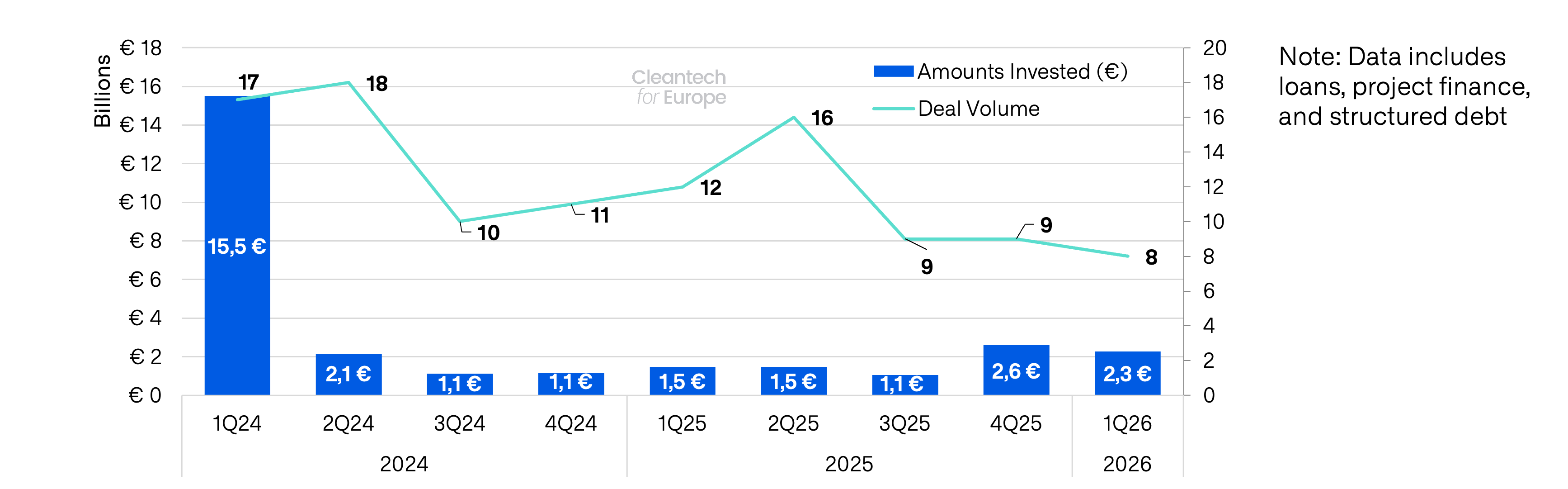
EU cleantech debt investment reached €2.3 billion across 8 deals in Q1 2026, slightly down from €2.6 billion in Q4 2025, but marking the second consecutive quarter above the €2 billion mark.
Deal count stood at 8, broadly in line with Q4 2025 (9 deals) and Q3 2025 (9 deals), confirming a market dynamic increasingly driven by fewer but larger tickets. This concentration reflects lender preference for more mature, de-risked cleantech assets.
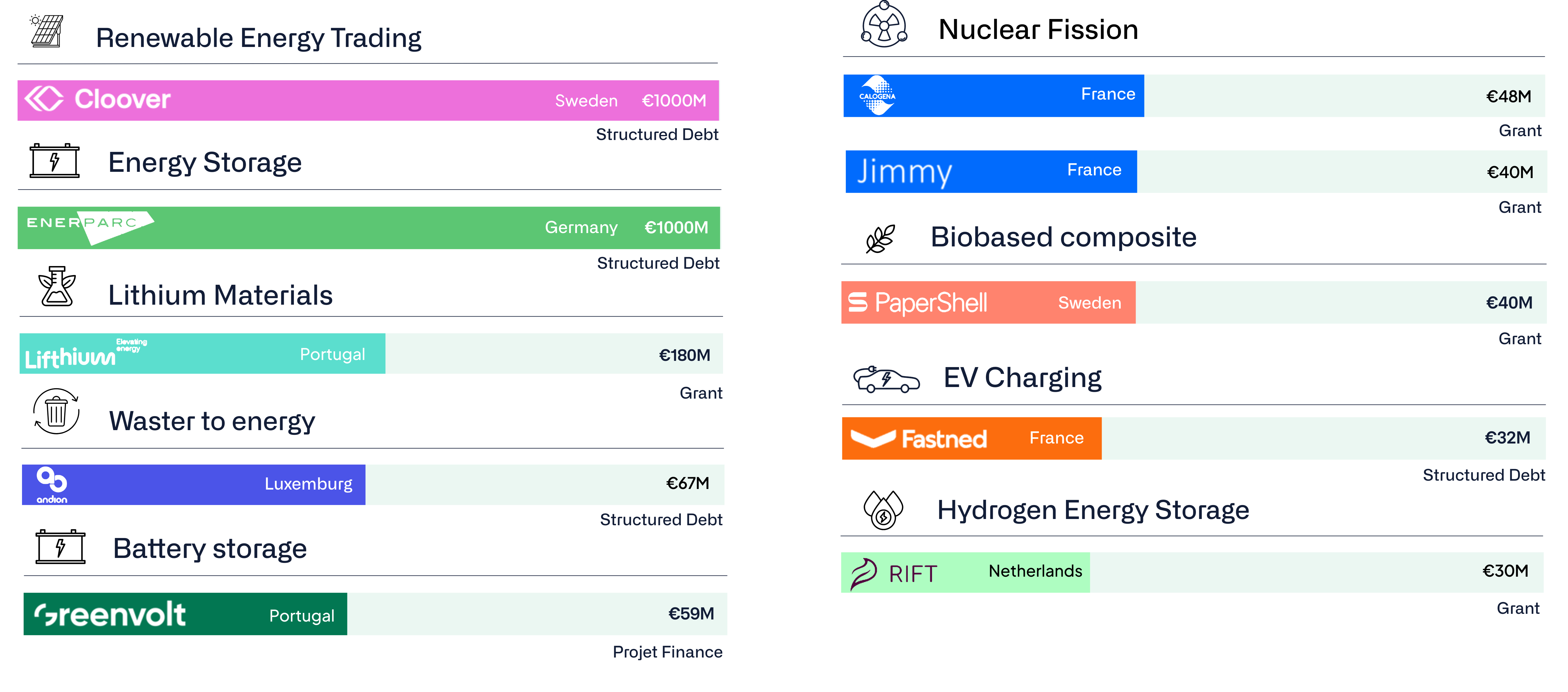
Major transactions included debt facilities to Cloover (€1 billion) and Enerparc (€1 billion), as well as grant for Lifthium (€180 million) and private credit facility for Andion CH4 Renewables (€67 million). Deals spanned energy-efficiency, battery storage, solar, and waste-to-renewable energy.
Remarkably, EU debt volumes overtook the US this quarter for the first time in recent memory, as US cleantech debt investment collapsed to just €2 billion across 10 deals –  down from €8.3 billion in Q4 2025 and €19 billion in Q2 2025. This sharp retrenchment in a historically deeper market likely reflects tightening credit conditions and shifting policy signals.
Unlocking growth-stage debt at scale remains critical for Europe’s clean industrial ambitions. As projects mature, bankable business models, blended finance structures, and public guarantees will be essential to bridge the gap with more mature credit markets abroad.
EU27 Cleantech Debt Investment, 2024 - Q1 2026

Top deals and activities

Beyond Equity
A Closer Look

€1b

In January, Germany-based Cloover secured a €1.02 billion debt facility from a major European bank, backed by a €300 million guarantee from the European Investment Fund, to scale its AI-powered software and financing platform for decentralised energy across Europe. The capital will be deployed as customer and installer financing to accelerate the rollout of solar panels, batteries, heat pumps, and other distributed energy technologies, positioning Cloover as the "Shopify of Energy."

€500m

In March, Germany-based ENERPARC secured a €1 billion debt package, comprising a €500 million medium-term loan from a consortium of global asset managers, alongside a long-term project financing framework of up to €425 million, with an accordion option that could raise it to €500 million. The capital will support the expansion of ENERPARC's solar and battery storage pipeline across Germany, France, and Spain, funding construction equity and covering both the construction and operational phases of facilities over the next five years.

€180m

In January, Portugal-based Lifthium Energy received a €180 million government grant, provided under the European Union's temporary crisis and transition framework, to build a battery-grade lithium refinery in Estarreja. Once completed in 2030, the refinery will have an annual capacity of 50,000 tons of lithium hydroxide, sufficient to supply batteries for approximately two million electric vehicles, reducing Europe's dependence on lithium imports from countries such as China.

€67m

In February, Luxembourg-based Andion CH4 secured a €67 million private credit facility led by Goldman Sachs Alternatives. The capital will support the expansion of Andion's biogas and biomethane project pipeline across Italy and the Nordic region, as the company pursues its mission to become a large European biomethane operator by converting organic waste streams such as food waste, agricultural residues, and wastewater sludge into renewable energy.

€58.9m

In January, Portugal-based Greenvolt signed €58.9 million in project finance facilities with UniCredit Bank Hungary to support the construction, operation, and maintenance of Project Buj, a 99MW/288MWh standalone battery energy storage system located in northeast Hungary. Once completed in the first quarter of 2026, Buj will be the largest battery energy storage asset in Hungary, enhancing grid flexibility and supporting the integration of renewable energy into the national power system.

€48m

In March, France-based Calogena received €48 million in public funding from France 2030 to support the development of its small modular nuclear reactor project, which aims to supply decarbonised heat to urban heating networks as a substitute for fossil fuels such as gas. The company plans to submit its authorisation application for its first reactor by 2028, with a demonstrator targeted for the early 2030s.

03

Latest from EU Policy

Policy Developments

Industrial Accelerator Act

On 4 March, the European Commission unveiled the Industrial Accelerator Act (IAA), amending the Net-Zero Industry Act. For the first time, the EU links public procurement and support schemes to Union-origin criteria across key clean technologies, marking a shift toward a more assertive "Made in Europe" industrial policy.
However, the final proposal is significantly weaker than earlier drafts: local content requirements cover a narrower scope, and generous escape clauses allow Member States to waive them on cost grounds. The broad definition of "Union-origin" further dilutes the demand signal.
From Cleantech for Europe perspective, Co-legislators should tighten the geographic scope to the EU/EEA, close value chain gaps (batteries, grids, electrolysers), clarify cost waiver thresholds, and build credible lead markets - or risk missing the reindustrialisation trajectory the IAA was designed to trigger.

Emissions Trading System (ETS) Revision

The EU ETS is at a critical juncture. Significant pressure has been building from a number of member states and energy-intensive industries calling for the system to be overhauled or substantially weakened, citing cost burdens on industry and the impact of carbon pricing on energy bills. This pressure must be carefully weighed against the systemic risks of undermining the instrument.
The carbon price signal underpinning the ETS is fundamental to providing the long-term investment certainty that industrial decarbonisation requires. Any revision that erodes the predictability or ambition of the system risks disrupting investment decisions already in progress, particularly for first-mover cleantech companies and low-carbon industrial projects currently advancing toward Final Investment Decision. The Commission's legislative proposal on the ETS revision is expected by July 2026.

28th regime and the definition of innovative scaleups

On 18 March, the European Commission presented the 28th regime package, centred on EU Inc. - an optional, digital-by-default corporate framework allowing entrepreneurs to set up a company anywhere in the EU within 48 hours. The package also includes a Recommendation on the definitions of innovative startups and scaleups, intended as a common reference across EU policies, including State aid rules.
This matters for cleantech: capital-intensive, pre-revenue models are often classified as "undertakings in difficulty", excluding them from key fast-track exemptions. However, the current definition is tailored to digital companies and misses capex-driven realities. Targeted adjustments will be essential ahead of the General Block Exemption Regulation revision expected in Q4 2026.

AccelerateEU Plan

On 22 April, the European Commission unveiled AccelerateEU, a comprehensive energy strategy responding to surging energy costs driven by Middle East conflict and ongoing exposure to volatile fossil fuel markets.
The plan centres on five pillars: enhanced EU coordination on gas storage and oil stocks; consumer and business protection through targeted support schemes and temporary excise duty reductions; accelerating homegrown clean energy through an electrification target and removal of sectoral barriers; upgrading the energy system via the EU Grids Package and 'Energy Highways' projects; and mobilising public and private investment through upcoming forums including the Clean Energy Transition Investment Forum in May 2026.
The urgency is underscored by the scale of Europe's fossil fuel exposure: €340 billion in import costs in 2025, with an additional €24 billion spent since the escalation of Middle East hostilities in March 2026.

ETCI 2.0 and Scaleup Europe Fund

Scaling cleantechs face a structural late-stage equity gap in Europe, critical to reach commercial scale and unlock the larger debt rounds that follow. The EU is stepping in.
In March, the EIB Group launched ETCI 2.0, the second iteration of the European Tech Champions Initiative, targeting €15 billion to back around 100 European growth funds, including, for the first time, mid-sized vehicles between €300M and €600M alongside mega-funds above €1B. A first closing of €2.5 billion is expected before summer.
In parallel, the Scaleup Europe Fund, announced as part of the Startup and Scaleup Strategy in 2025, will be a privately managed, co-financed vehicle making direct equity investments in strategic sectors including cleantech. The asset managers selected to run the fund are expected to be unveiled in April.

04

What the future holds

in focus
the US drills deep, China scales fast, and Europe risks missing the geothermal revolution

Geothermal is a system-scale opportunity, not a niche resource. Next-generation systems alone could generate 301 TWh annually in the EU – equivalent to 42% of EU coal- and gas-fired generation. Geothermal can fast-track industrial decarbonisation, replace imported gas in heat and power, support grid stability, and enable domestic lithium production – all from largely underground, distributed infrastructure that is harder for adversaries to attack.
The U.S. is deploying significant public funding and backing first-of-a-kind projects to accelerate next-generation geothermal, while China is massively scaling deployment of conventional geothermal – often using European expertise. Europe remains a technological leader, with the skills, supply chain and oil & gas workforce ready to be repurposed – yet deployment stalls.
Europe's bottleneck is not technology, but political ambition. The cost and risk profile of initial drilling blocks next-gen projects from reaching financial close, long-term revenue frameworks are missing, and permitting, land-use and grid connection remain slow and fragmented. The Commission’s upcoming Geothermal Action Plan is a timely recognition, but risks focusing too narrowly on heat and leaving next-gen geothermal as a secondary priority.
A broad industry coalition – 60+ signatories alongside Cleantech for Europe, Future Cleantech Architects, and the European Geothermal Energy Council – has called on the Commission to match ambition with action: a dedicated EU geothermal de-risking facility (in the spirit of recent SMR and Battery Booster commitments), bankable revenue frameworks (two-way CfDs, clean firm auctions, PPAs and heat purchase agreements), time-bound permitting and an EU-wide geothermal atlas, and a European Geothermal Industry Alliance to drive scale-up.
Europe has the technology. The question is whether it will scale it at home – or watch others do it again.
For more on this topic:

Our open letter : Europe Risks Missing the Geothermal Revolution

Latest news
from Cleantech for Europe

Launch of Electrolysers for Europe

A new coalition, Electrolysers for Europe, has been launched in March as the unified voice of Europe's electrolyser manufacturers, with Cleantech for Europe acting as its secretariat.
The coalition brings together leaders across the full value chain: ITM Power, John Cockerill, Nel Hydrogen, Sunfire, thyssenkrupp nucera, and Topsoe, from manufacturers to system integrators and engineering partners, working to align industry and policymakers around a common vision for 2030 and beyond.
A strategic sovereignty issue: 95% of hydrogen used in Europe is still fossil-based. Scaling electrolytic hydrogen replaces this dependency with a domestic, secure, renewable alternative.
An industry ready to scale: European manufacturing capacity has grown tenfold, from 1 GW to over 10 GW. To maintain leadership amid intensifying global competition, the coalition calls for stable frameworks, demand-side incentives, and clear Made in Europe criteria.
Read the manifesto here.

Launch of the IEA Energy Technology Perspectives 2026 Report with the Cleantech Friendship Group

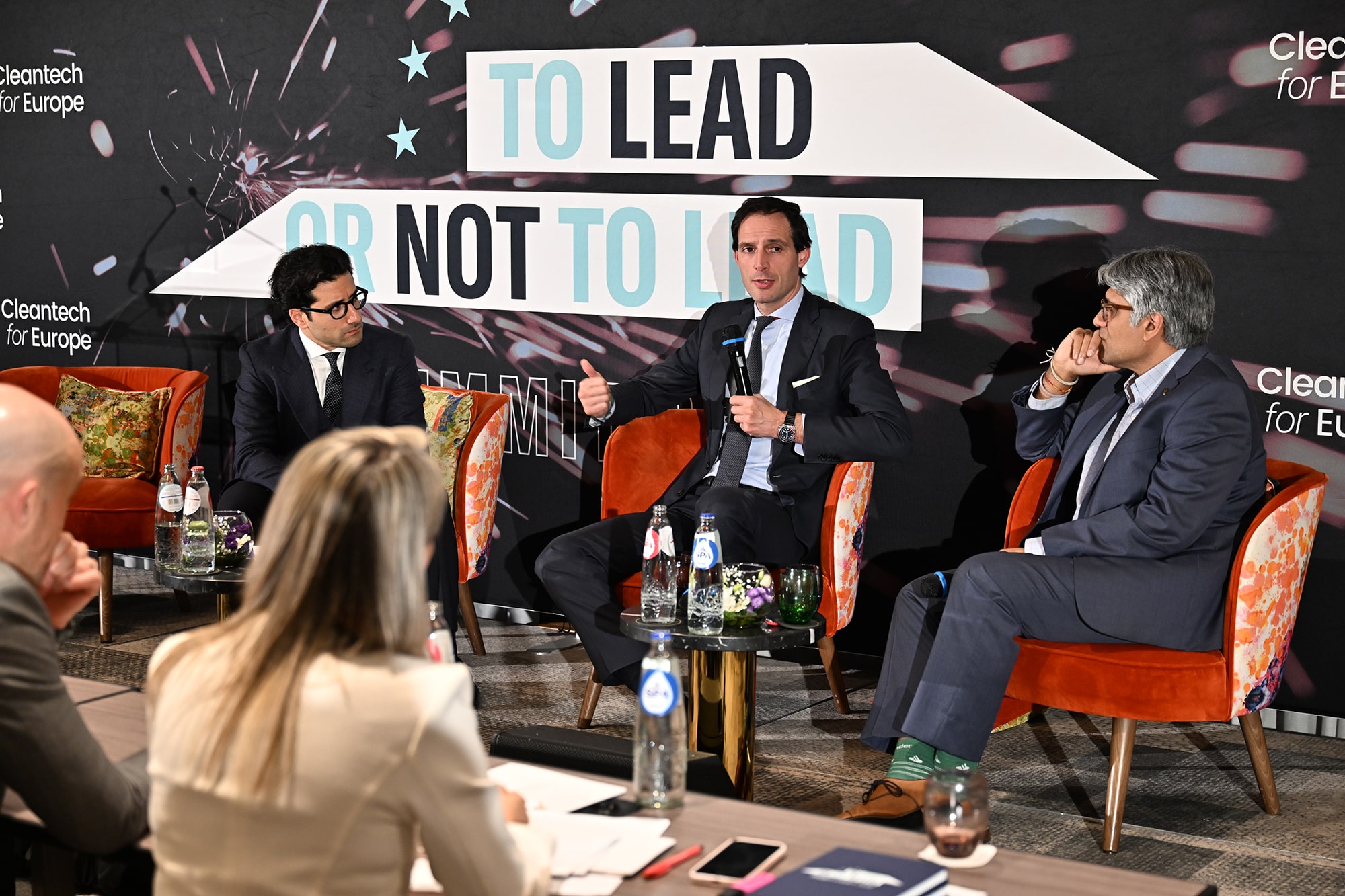
In April, Cleantech for Europe co-hosted with the International Energy Agency and the Cleantech Friendship Group the Brussels launch of the IEA's Energy Technology Perspectives 2026 report at the European Parliament. The event gathered policymakers, industry leaders and investors to discuss Europe's industrial competitiveness in a rapidly shifting global cleantech landscape.
We had the pleasure of having MEPs Lídia Pereira and Thomas Pellerin-Carlin, Co-Chairs of the Cleantech Friendship Group, host the discussion, Timur Gül (IEA) present the report, and Philipp Offenberg (Siemens Energy) bring an industry perspective in a panel moderated by our Executive Director Jules Besnainou.
Key takeaways: the global market for mass-manufactured clean energy technologies is set to grow from USD 1 trillion in 2025 to nearly USD 3 trillion by 2035; China's dominance is striking; and supply chain concentration poses a major economic security risk. Europe retains strong innovation capabilities but risks falling behind at the scale-up stage. The message was clear: Europe can still lead, but the window to move from ambition to deployment is narrowing.
Download the printable version
Policy Voices
Policy Voices
Scale-up Coalition
Scale-up Coalition
Industrial Decarbonisation
EU Funding
EU Funding
Regional Initiatives
Company News
Company News
In the Press
In the Press
Voices of Innovation
Cleantech Investors
Cleantech Investors
Policy Voices
Policy Voices
Scale-up Coalition
Scale-up Coalition
Industrial Decarbonisation
EU Funding
EU Funding
Regional Initiatives
Company News
Company News
In the Press
In the Press
Voices of Innovation
Cleantech Investors
Cleantech Investors