eu cleantech
ANNUAL briefing
Download the printable version
2025

2026 Is Europe’s Cleantech’s Scale or Fail Moment

VICTOR VAN HOORN
Director
As Europe enters 2026, it is worth stepping back and situating today’s cleantech debate in its proper historical context. Headlines often focus on the recent slowdown in venture and growth investment, suggesting a sector in retreat as the low-interest-rate environment of 2021-22 fades and topline investment levels in 2024 and 2025 remain below early-2020s peaks. Yet when viewed over a full decade, the picture is very different: cleantech investment levels throughout the 2020s – including in 2025 – remain far higher than the annual averages of the latter half of the 2010s.

The data in this Annual Briefing confirms both Europe’s progress and its constraints. Europe continues to lead in clean technology innovation and early deployment, but 2025 marked a second consecutive year of declining venture and growth equity and persistent late-stage financing gaps, proving technologies is no longer the bottleneck. Scaling and manufacturing them in Europe is.

At the same time, the broader context has shifted decisively. Sovereignty has become a defining concern – economically, industrially, and geopolitically. Governments are reasserting control over energy systems, supply chains, and strategic industries; companies are seeking resilience against shocks; and trade is increasingly shaped by power rather than rules. China’s export-driven growth model, low domestic consumption, and dominance across key clean technology value chains continue to generate overcapacity and trade frictions, while both China and the United States openly pursue decoupling strategies.

Europe is only now fully internalising this reality. In 2025, that awakening became visible; in 2026, it must translate into action. Signals of a harder-edged approach are emerging – from the suspension of approval of the EU-US trade deal, to discussion of deploying the Anti-Coercion Instrument, to growing acceptance that reciprocity must matter in trade and industrial policy.

Europe remains open to the world, but it can no longer afford to be naïve. Many partners, including India, Brazil, and the United States, actively deploy industrial policy tools, including local content incentives, to build domestic clean industries. It is neither protectionist nor unreasonable for Europe to ensure that its public money supports strategic clean supply chains at home.

The stakes are rising. Energy-related supply chain security now extends beyond oil and gas to electricity systems, grids, critical raw materials, and cyber risks. The AI-driven data-centre boom is accelerating electricity demand and straining infrastructure, while creating strong demand pull for energy-efficient computing, liquid cooling, grid technologies, and clean baseload power. In parallel, investment momentum is building in critical raw materials, grids, geothermal, and technologies that de-risk supply chains and enable decentralised systems increasingly valued by industry and defence communities alike.

Policy developments in 2025 reflect this shift. The Clean Industrial Deal, the Industrial Accelerator Act, reforms to public procurement, the Electrification Action Plan, and debates on ETS, CBAM, and the Innovation Fund all point to growing recognition that decarbonisation, competitiveness, and resilience must be pursued together. Yet Europe still moves too slowly. Institutional fragmentation, procedural drag, and intra-EU competition continue to dilute impact and undermine strategic coherence.

Europe’s challenge is not a lack of power, capital, or innovation, it is the difficulty of organising them. Hesitation risks reinforcing a self-fulfilling cycle of fragmentation and perceived weakness. But recent experience also shows that firmness, unity, preparedness, and willingness to engage can shift outcomes when Europe acts together.

There is reason for cautious optimism. Clean technologies are increasingly outperforming fossil alternatives on cost and quality. In 2025, wind and solar generated more electricity than fossil fuels in Europe for the first time, and electric vehicles overtook internal combustion sales in December. These trends will continue. The question is whether Europe captures their industrial and economic value.

The choice ahead is clear. Europe must move beyond the fallacy that technological demonstration is the finish line. What matters is whether Europe can scale, manufacture, and deploy the clean technologies it invents and do so fast enough to compete in a harsher global order. Getting this right is not only about climate leadership; it is about industrial strength, economic security, and sustaining Europe’s social model.

Cleantech for Europe exists to support that effort by grounding policy in data and insights from the community of European cleantech companies and investors. The year ahead will test whether Europe can match its mindset shift with the speed and coordination the moment demands.


Executive Summary

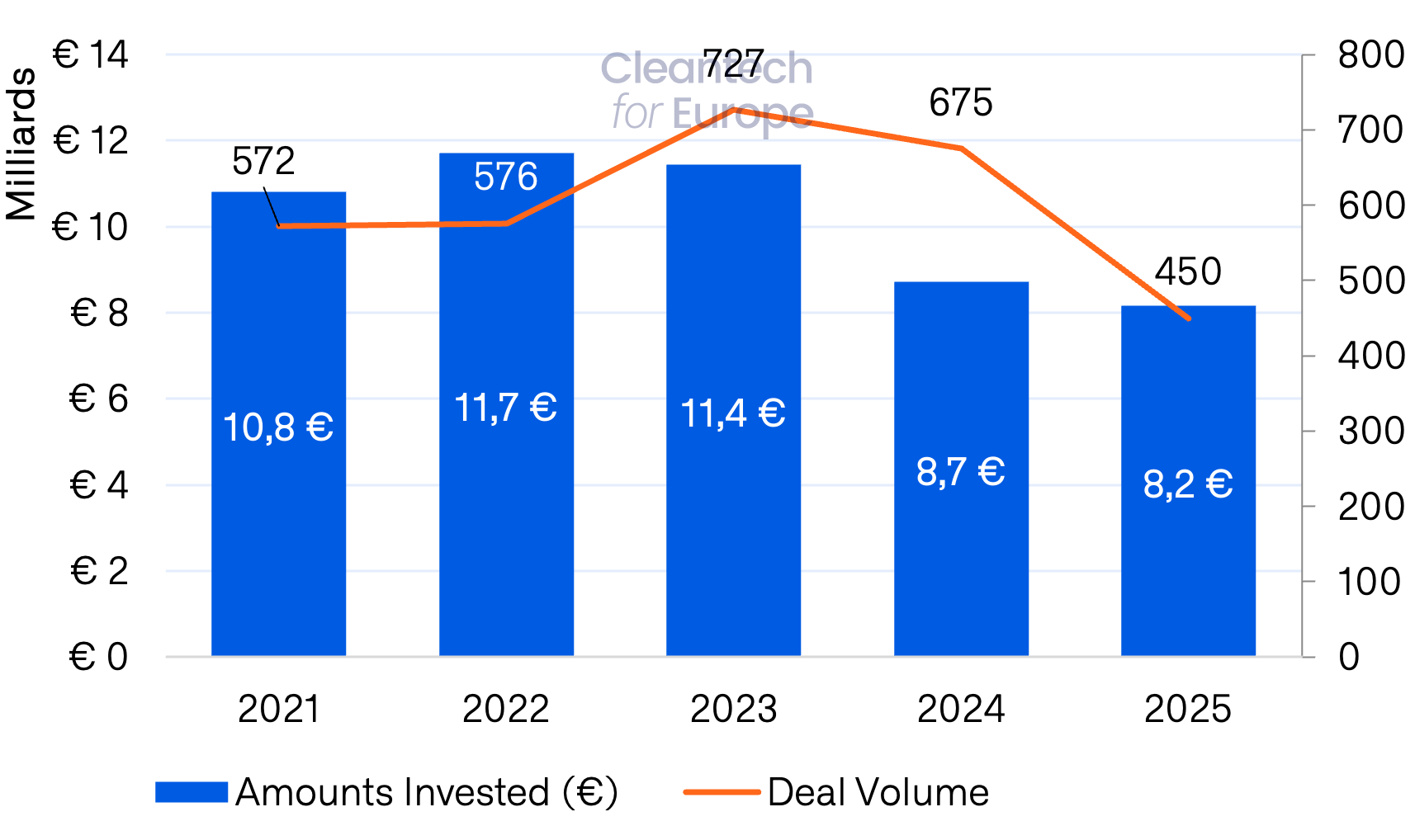
EU cleantech VC and growth equity investment declined to €8.2bn in 2025, down from €8.7bn in 2024, confirming a sustained post-peak contraction.
Deal activity fell sharply to 450 deals, from 675 in 2024 and a peak of 727 in 2023, reflecting a broad slowdown across the venture pipeline.
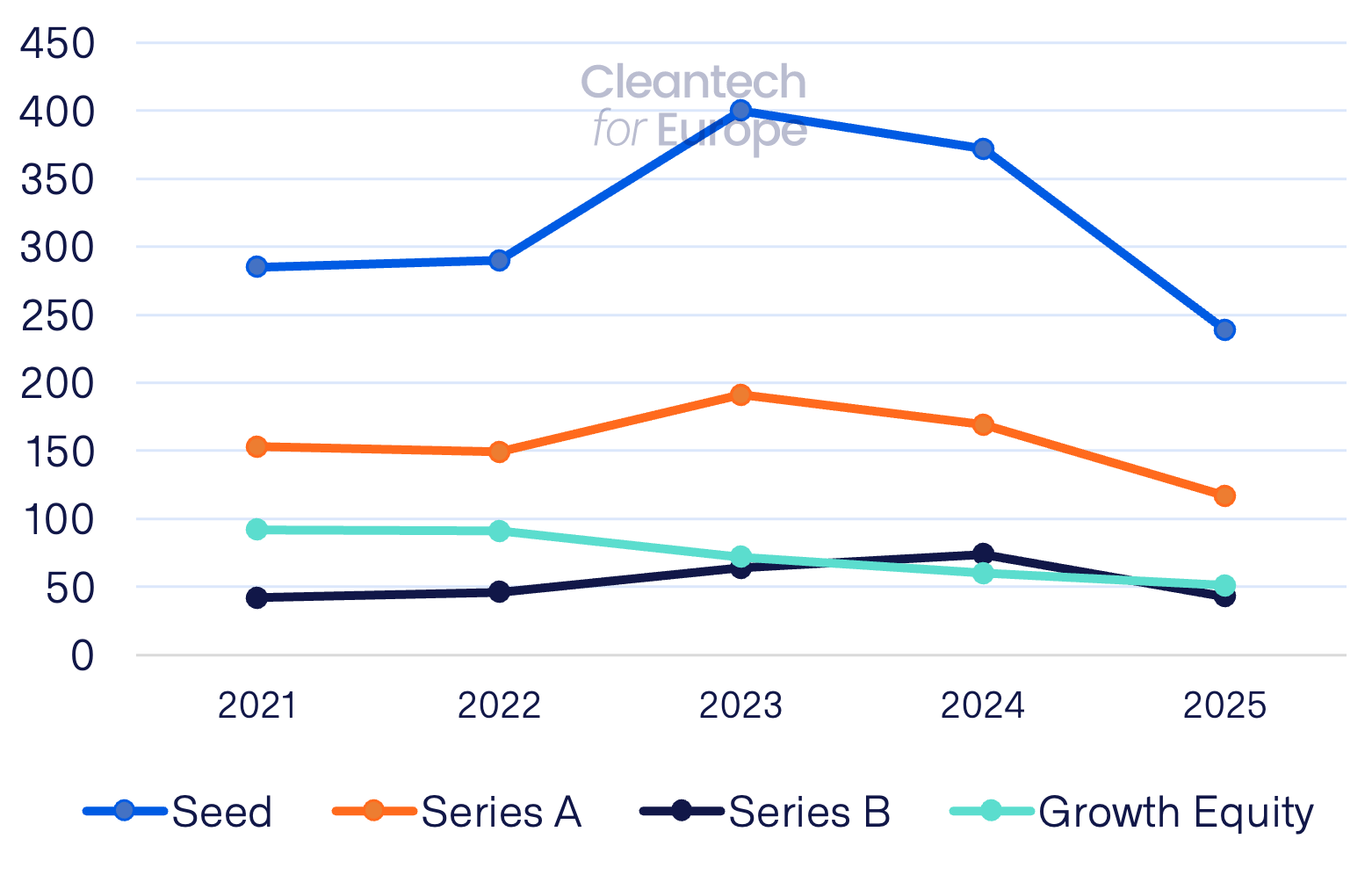
Series B investment weakened significantly, with deal volume dropping from 74 to 43 deals and total investment falling to €1.8bn (from €2.9bn in 2024), tightening funding at the critical scale-up stage.
Growth Equity investment proved more resilient, rising to €3.5bn in 2025 (up from €2.7bn), though deal counts continued to decline, remaining insufficient to support large-scale commercialization.
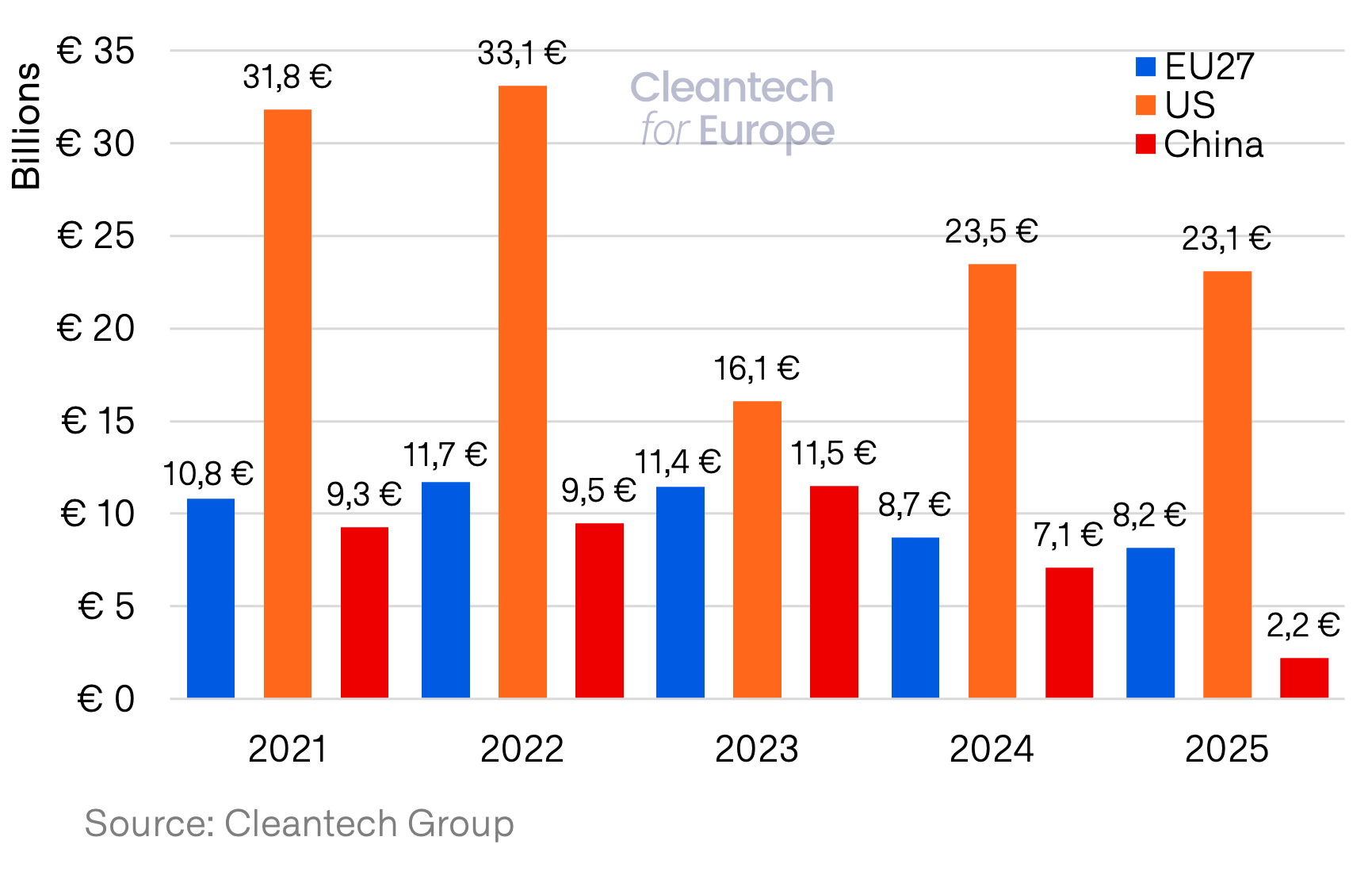
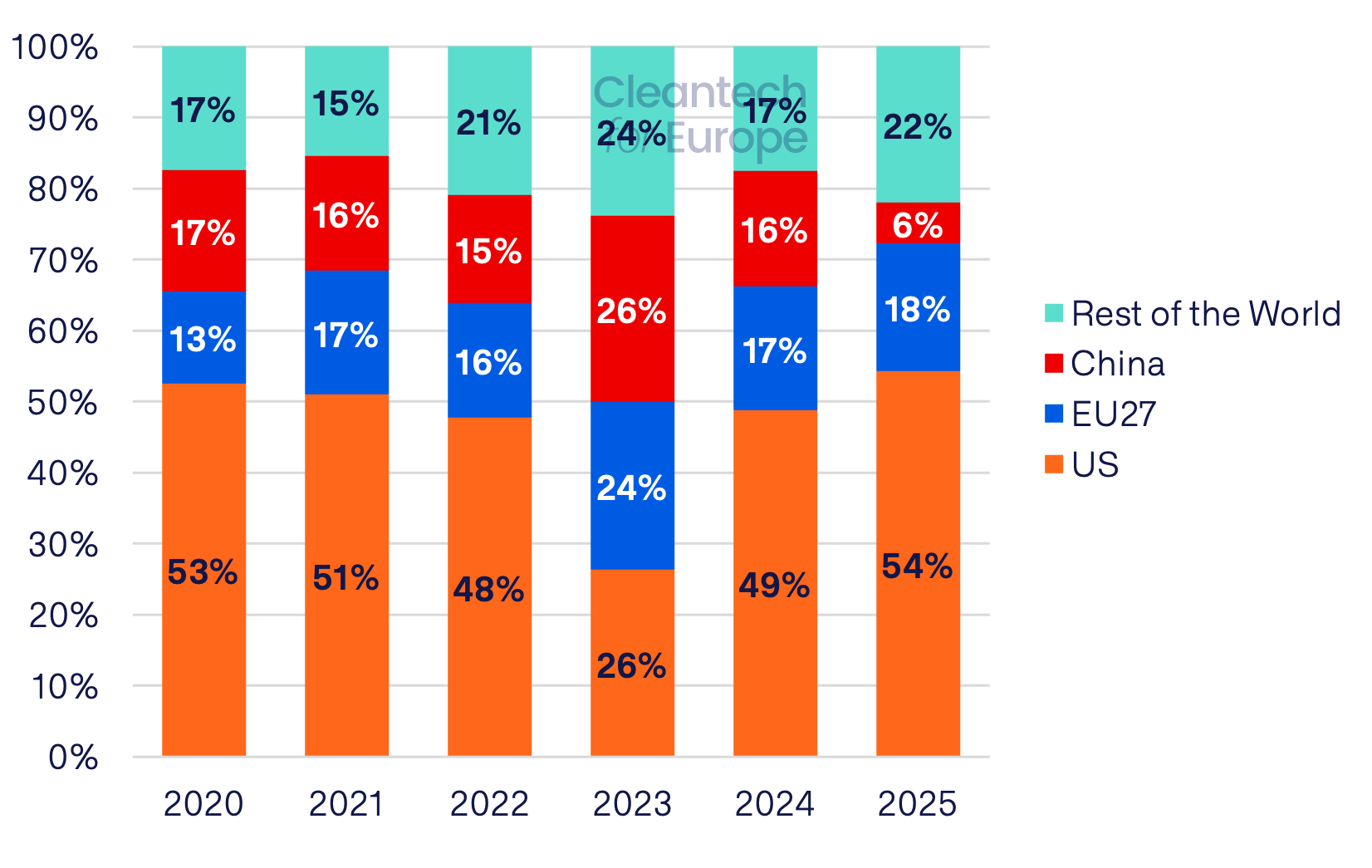
The EU continued to lag global peers, investing €8.2bn versus €23.1bn in the US; China fell further to €2.2bn. The EU captured 18% of global investment, compared to over 54% for the US.
Geographic reach narrowed, with deals across 19 EU member states (down from 23 in 2024). Germany, France, the Netherlands, Spain, and Sweden led deal activity.
Cleantech debt investment normalised to €12bn across 61 deals, down from a €23.4bn peak in 2024, underlining continued reliance on public lenders to de-risk late-stage projects.
The Clean Industrial Deal, presented in February 2025, marked a central shift in EU industrial policy, aiming to turn decarbonisation into a driver of growth by lowering energy costs, supporting energy-intensive industries, and strengthening the cleantech sector at the core of Europe’s future competitiveness.
Cleantech for Europe played a central role in the policy debate, pushing for an ambitious agenda and , more recently, stronger demand-side measures to accelerate the uptake of clean products Made in Europe.
In June 2025, the EIB approved a major expansion of cleantech de-risking tools under its TechEU programme, including a €250m CleantechEU Guarantee Scheme, a €500m PPA counter-guarantee pilot, and €3bn in guarantees for grid and wind manufacturing. A €2.5bn increase to InvestEU reinforced this momentum.
The Clean Industrial State Aid Framework (CISAF), also unveiled in June, expanded Member States’ flexibility to support cleantech manufacturing, though the absence of production-based incentives remains a key gap versus the US IRA.
The European Commission announced the Scaleup Europe Fund in October 2025, a €5bn market-driven vehicle backed by the EC, EIB and institutional investors to address Europe’s late-stage equity gap and keep cleantech scale-ups manufacturing in Europe.
Economic security moved to the forefront in December, with the launch of ResourceEU to reduce critical raw material dependencies, even as delivery risks and geopolitical pressures continued to mount.
“Made in Europe” is central to EU industrial policy. The Industrial Accelerator Act (IAA), provisionally scheduled for 25 February, will complement the Clean Industrial Deal and Competitiveness Compass, reflecting its strategic and political importance.
The IAA aims to strengthen market creation tools, including public procurement, auctions, and access to public funding, with debate focused on explicit “Made in Europe” or local content requirements for strategic cleantech.
Policy design is key. The Commission seeks a phased, flexible approach to mitigate costs, WTO risks, and internal market fragmentation, while avoiding supply shortages and inflation spikes.
Demand-side signals must be clear. Sustainability and resilience criteria alone are inconsistent and weak, limiting private capital mobilization for European cleantech scale-up.
In an open letter co-signed by 115 cleantech ecosystem stakeholders, Cleantech for Europe called for targeted European preference, applied proportionately to strategic technologies, phased 2026–2030, aligned across EU and national funding, and complemented by FDI screening and joint-venture rules to ensure real technology transfer and long-term industrial value creation.
The Industrial Accelerator Act (IAA), expected in early 2026 after delays, will be a pivotal test of Europe’s clean industrial ambition. Ahead of its release, over 100 cleantech companies and investors called for strong “Made in Europe” demand criteria to ensure EU funding creates predictable markets, unlocks private capital, and strengthens Europe’s competitiveness and strategic autonomy.
Negotiations on the 2028–2034 EU budget (MFF) will intensify in 2026, shaping the financial backbone of Europe’s cleantech industrial strategy. With public finances under pressure, the focus will be on guarantees and de-risking tools, stronger coherence between InvestEU, the Innovation Fund and the European Competitiveness Fund, and anchoring spending in European value chains.
The proposed Grids Package, presented in late 2025, will be closely watched as it moves toward implementation. While it promises stronger EU-level planning and cross-border “energy highways,” slow timelines and limited support for EU grid manufacturing raise concerns over execution speed and strategic autonomy.
The EU Emissions Trading System (ETS) review, launched in 2026 following the 2040 climate target, represents a critical juncture. The outcome will determine whether the ETS is weakened by legacy interests or reinforced as a credible tool for clean industrial investment and scale-up.
Reform of EU public procurement rules, with legislation expected in 2026, could turn procurement into a strategic lever for creating European lead markets, notably through potential “Made in Europe” preferences aligned with the IAA.
The Electrification Action Plan, due in early 2026, will be key to accelerating clean demand, with success hinging on affordable electricity, grid access, flexibility, and support for industrial heat electrification.

01

2025: An other Challenging Year for EU Cleantech Investment

8.2
billion

INVESTED IN EU CLEANTECH IN 2025

Investment amounts and dealvolume dipped.

EU TRENDS

EU cleantech VC investment declined in 2025, with total investment dropping to €8.2 billion, down from €8.7 billion in 2024, confirming a sustained post-peak contraction.
Deal activity dropped sharply to 450 deals, down from 675 in 2024 and a peak of 727 in 2023, reflecting a broad-based slowdown across the venture pipeline.
Series B investment weakened sharply in 2025, with deal volume falling from 74 to 43 deals and total investment dropping to €1.8B, down from €2.9B in 2024, signalling a squeeze at the critical scale-up stage.
Growth Equity investment proved relatively more resilient, with volumes increasing to €3.5B in 2025 (up from €2.7B in 2024), despite deal counts continuing to decline from 60 to 51. However, this remains insufficient to support the commercialization of clean technologies in Europe. By comparison, US Growth Equity investment reached around €15B across roughly 140 deals in 2025, highlighting the persistent gap in Europe’s ability to finance cleantech scale-up at scale.
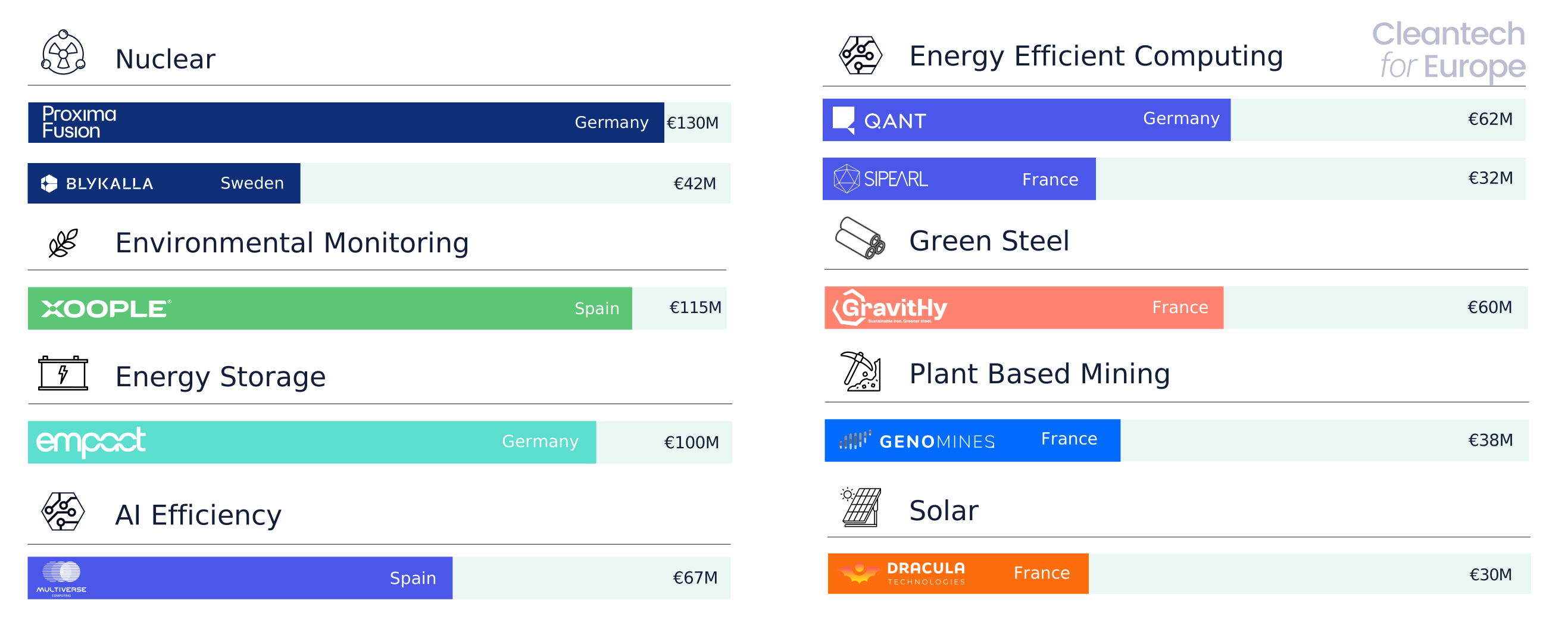
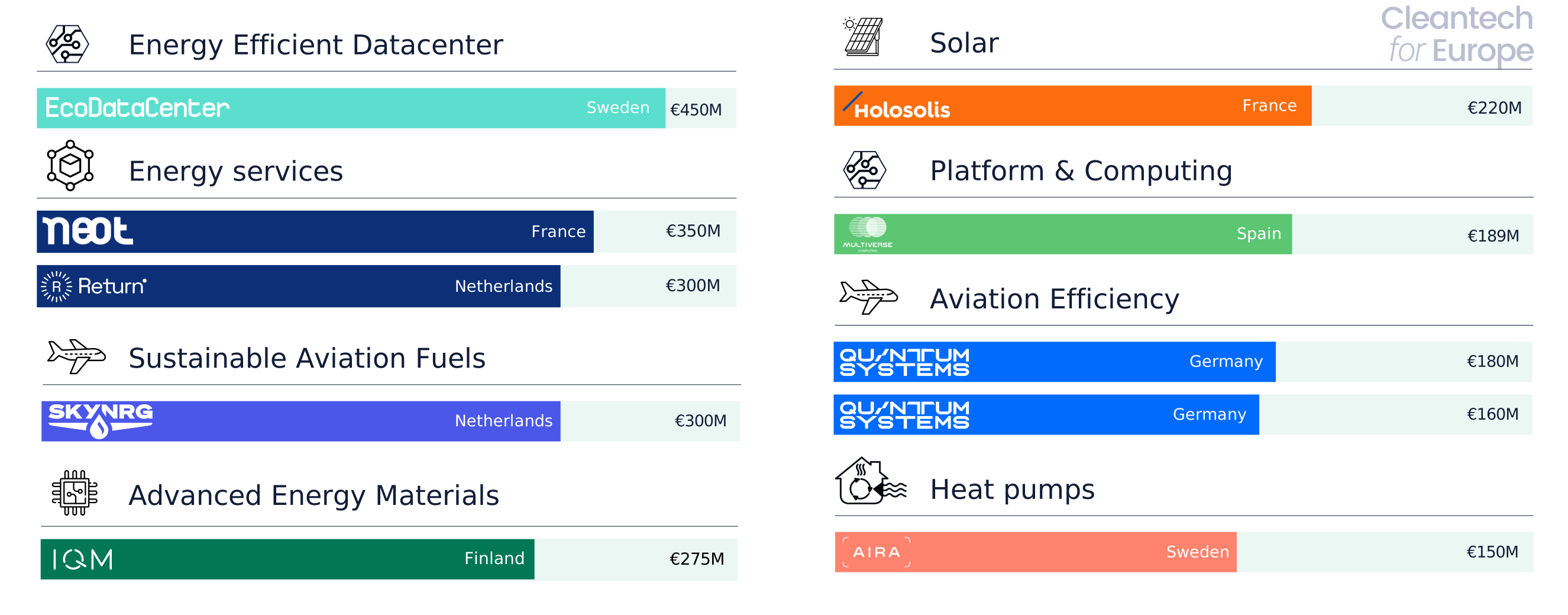
The largest equity deal of 2025 was Sweden-based EcoDataCenter’s €450m Growth Equity round, highlighting how the AI data-center boom is driving demand pull across the cleantech value chain. Energy-efficient computing, clean energy sources, and grid technologies are among the sectors continuing to attract equity, as rising electricity demand from AI accelerates infrastructure investment.
EU27 Cleantech Seed, Series A, Series B and Growth investment,
2021-25
EU27 Cleantech Venture & Growth deals by stage,
2021-25

COMPARED TO GLOBAL PEERS

EU cleantech VC investment continued to lag global peers in 2025, falling to €8.2bn, compared to €23.1bn in the US, while China saw a second consecutive year of sharp contraction to €2.2bn.
The EU’s share of global cleantech venture and growth investment edged up slightly to 18% in 2025, but remains structurally below the US, which captured over 54% of global investment, reinforcing its dominant position.
The US remains the only major cleantech ecosystem to sustain high investment volumes through the downturn, supported by a deep capital stack, much of the Inflation Reduction Act (IRA) being preserved in the One Big Beautiful Bill Act (OBBBA), and robust demand from Big Tech companies and hyperscalers in particular.
As global cleantech investment increasingly concentrates in the US, Europe risks falling further behind unless it delivers stronger demand signals for cleantech Made in Europe and scale-up financing conditions for capital-intensive projects.
Cleantech Venture Capital by Region, 2021-25
Global Cleantech Venture Capital share by Region, 2021-25

MEMBER STATES ACTIVITY

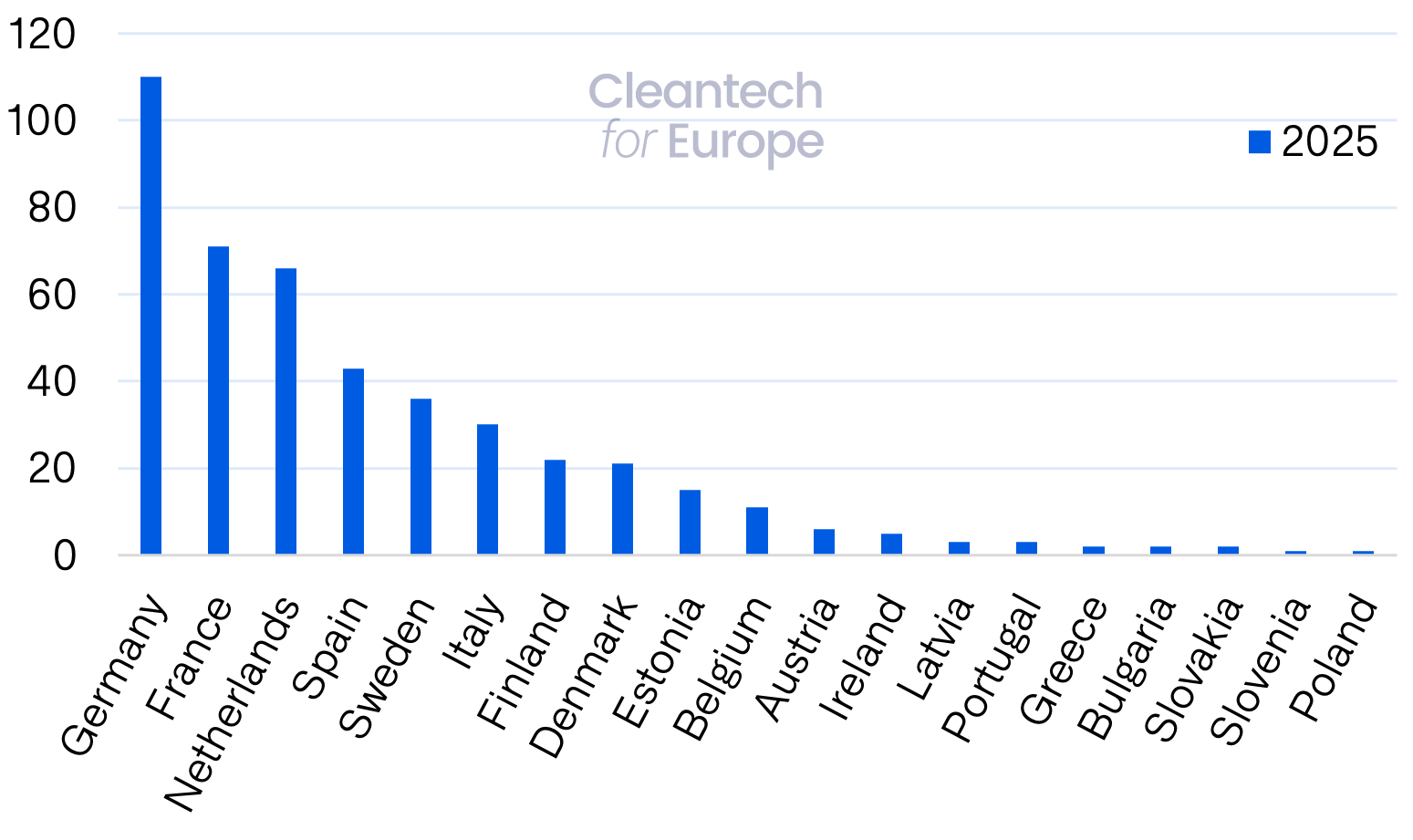
Cleantech venture and growth equity deals took place across 19 EU member states in 2025, down from 23 in 2024, reflecting a further contraction in geographic reach as overall deal activity slowed.
The ‘big five’ – Germany (110 deals), France (71), the Netherlands (66), Spain (43), and Sweden (36) – continued to lead in absolute deal count, though Spain overtook Sweden in 2025. Italy (36) had its most active year on record in terms of deal count.
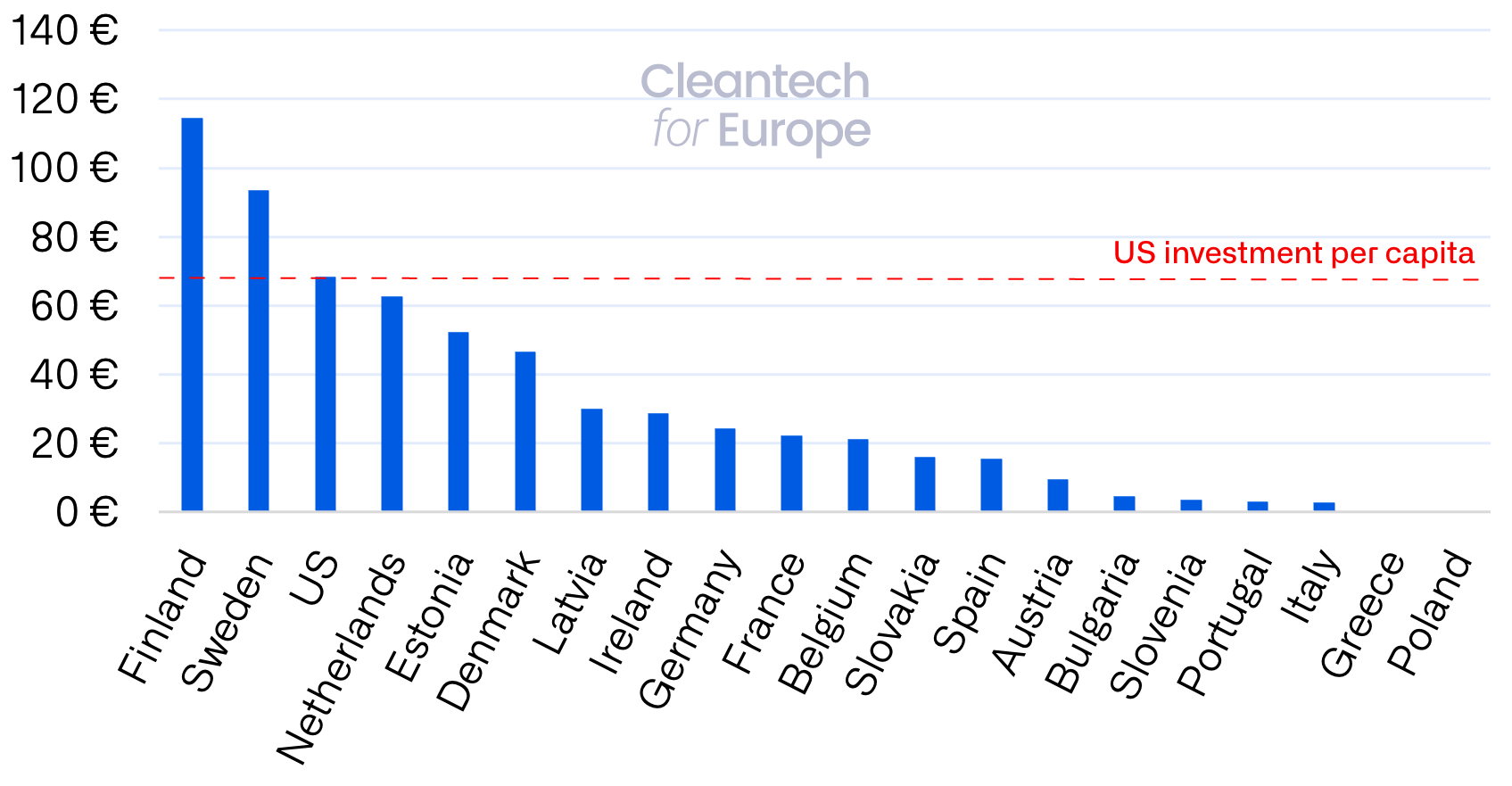
Per-capita investment levels remain highly uneven across the EU. In 2025, Finland (€115), Sweden (€94), the Netherlands (€63), and Estonia (€52) recorded the highest cleantech investment per capita, while most large member states remained well below these levels.
Only two EU countries – Finland and Sweden – exceeded US (€24) per-capita cleantech investment of in 2025, while major economies such as Germany (€24), France (€22), Spain (€16), and Italy (€3) continued to lag, highlighting persistent structural disparities in Europe’s cleantech investment landscape.
Number of EU Cleantech Venture & Growth Equity Deals
by member state, 2025
EU Cleantech Venture & Growth Equity Investment
by Member State, 2025

Q1 Deal distribution:
geography & sector

Cleantech venture capital deals took place in 17 out of 27 EU member states. Efforts must be continued to ensure the cleantech scale-up is a growth opportunity for an increasing number of EU countries.
Looking at deal count, the most active countries were Germany, Sweden, France, Spain, and the Netherlands. Germany took the leading spot again, while France saw a 53% decrease from last quarter, falling from first to third place, tied with Spain. After two consecutive quarters of decline, deal activity rebounded strongly in Sweden to it’s highest level since 2021. Meanwhile, deal activity slowed in the Netherlands and Italy.
Innovation in Transportation & Logistics (T&L) garnered the largest share of investment this quarter (31%), returning to its rough annual EU cleantech venture investment share of 2020-2022 following a lacklustre 2023. Investment may have been bolstered by supportive recent policy signals at the EU level. These include:
• the 2035 Internal Combustion Engine ban for new cars approved, in 2023
• an ambitious deal on the decarbonization of heavy-duty vehicles agreed in February
• a deal on charging infrastructure agreed in 2023
• deals on the Batteries Regulation and Critical Raw Materials Act
However, the EU’s investment still pales in comparison to China’s large and growing T&L venture investment, which reached €1.6 billion in Q1.
The strong traction for the T&L sector was driven by large deals in EV charging (Electra Charging, Powerdot, Monta), autonomous EVs (Project 3 Mobility), and electric aviation (heart aerospace).
Deals by Member State, Q1 2024
EU cleantech VC investment by sector, Q1 2024
Q12024_early_Sensors
Sensors
France
€15M
€15M
Q12024_early_Alternativeproteins
Alternative proteins-Q124
Germany
€15M
€15M
Q12024_early_wastemanagementq124
Waste management-q124
France
€21M
€21M
Q12024_early_industrialmaterials
Industrial Materials
France
€23M
€23M
Q12024_early_carbonremovals
Carbon Removals
Germany
€25M
€25M
Q12024_early_energystorage
Energy Storage
Finland
€26M
€26M
Netherlands
€15M
€15M
Q12024_early_transportation
Transportation
Croatia
€99M
€99M
Austria
€20M
€20M
Italy
€15M
€15M
AB2023_early_Construction
Construction
Germany
€45M
€45M
AB2023_early_Hydrogen Fuel Cells
Hydrogen Fuel Cells
France
€46M
€46M
AB2023_early_Nuclear fission
Nuclear fission
France
€50M
€50M
AB2023_early_Supply chain Logistics
Supply chain & Logistics
Germany
€50M
€50M
AB2023_early_EV Charging
EV Charging
Germany
€70M
€70M
AB2023_early_Heat pumps
Heat pumps
Sweden
€86M
€86M
AB2023_early_Carbon Management
Carbon Management
Germany
€100M
€100M
AB2023_early_Green IT
Green IT
France
€100M
€100M
France
€90M
€90M
AB2023_early_Electric Vehicles
Electric Vehicles
France
200M
200M
3Q23__Others__Logistics
Transportation & Logistics
Germany
€177M
€177M
3Q23__Others__Hydro
Green Hydrogen
Germany
€169
€169
Netherlands
€130M
€130M
3Q23__Others__CRM
Critical Raw Materials
Ireland
€184
€184
3Q23__Others__Plastic
Plastic Alternatives
Netherlands
€338M
€338M
Germany
€130M
€130M
3Q23__Others__Energy
Energy & Power
Germany
€685M
€685M
3Q23__Others__EV
EV Batteries
Sweden
1100M
1100M
France
€650
€650
France
€600M
€600M
3Q23__Late__Energy
Energy & Power
Sweden
€45M
€45M
3Q23__Late__Hydro
Green Hydrogen
Portugal
€61M
€61M
3Q23__Late__Agri
Agriculture & Food
Belgium
€72M
€72M
Netherlands
€32M
€32M
3Q23__Late__Solar
Solar
Lithuania
€93M
€93M
3Q23__Late__Construction
Buildings & Construction
France
€106M
€106M
Ireland
€26M
€26M
Netherlands
€25M
€25M
3Q23__Late__EV
EV Batteries
France
€850M
€850M
3Q23__Late__Steel
Green Steel
Sweden
€1500M
€1500M
3Q23__Early__Geo
Geospatial Imagery
Germany
€17M
€17M
3Q23__Early__Transportation
Transportation & Logistics
Germany
€18M
€18M
Spain
€16M
€16M
3Q23__Early__Quantum
Quantum Computing
France
€19M
€19M
3Q23__Early__Energy
Energy & Power
Germany
€25M
€25M
3Q23__Early__Agriculture
Agriculture & Food
Denmark
€30M
€30M
3Q23__Early__Plastic
Plastic Alternatives
Germany
€36M
€36M
Finland
€23M
€23M
3Q23__Early__Construction
Buildings & Construction
Germany
€45M
€45M
Germany
€22M
€22M
2Q23__Late__Carbon
Carbon Management
Luxembourg
€34M
€34M
2Q23__Late__Agri
Agriculture
France
€162
€162
2Q23__Late__EV
EV Charging
France
€252M
€252M
Germany
€153M
€153M
Finland
€66M
€66M
Ireland
€57M
€57M
2Q23__Late_Energy
Energy, Energy Storage & Networks
Germany
€433
€433
Germany
€370M
€370M
Sweden
€90M
€90M
Italy
€41M
€41M
2Q23__Early__Electro
Electronic Devices
Germany
€20M
€20M
2Q23__Early__Biotech
Biotechnology
Germany
€20M
€20M
2Q23__Early__Construction
Buildings, Building Materials & Construction
France
€29M
€29M
France
€20M
€20M
2Q23__Early__Logistics
Transportation, Supply Chain & Logistics
Germany
€41M
€41M
Germany
€29M
€29M
France
€21M
€21M
Austria
€18M
€18M
2Q23__Early__Green-IT
Green IT
France
€91M
€91M
2023-Q1-chart__series-B__geo
Geothermal
France
€45M
€45M
2023-Q1-chart__series-B__waste
Waste Management
Netherlands
€50M
€50M
2023-Q1-chart__series-B__agrifood
Agriculture & Food
Denmark
€65M
€65M
Denmark
€47M
€47M
2023-Q1-chart__series-B__buildings
Buildings & Construction
Austria
€93M
€93M
Germany
€44M
€44M
2023-Q1-chart__series-B__blockchain
Blockchain
No items found.
2023-Q1-chart__series-B__solar
Solar
Germany
€215M
€215M
Italy
€117M
€117M
Sweden
€29M
€29M
2023-Q1-chart__series-A__solar
Solar
Ireland
€15M
€15M
2023-Q1-chart__series-A__heatpumps
Heat Pumps
Netherlands
€15M
€15M
2023-Q1-chart__series-A__fusion
Nuclear Fusion
France
€15M
€15M
2023-Q1-chart__series-A__energy
Energy & Power
Slovakia
€16M
€16M
2023-Q1-chart__series-A__agrifood
Agriculture & Food
Netherlands
€21M
€21M
2023-Q1-chart__series-A__geospatial
Geospatial imagery
Latvia
€28M
€28M
2023-Q1-chart__series-A__transportation
Transportation and Logistics
Germany
€42M
€42M
France
€21M
€21M
Germany
€15M
€15M
2023-Q1-chart__series-A__buildings
Buildings
Sweden
€42M
€42M
2023-Q1-chart__series-A__carbon-management
Carbon Management
Germany
€101M
€101M
2022-Q3-chart__transportation-logistics
Transportation & Logistics
Belgium
€20M
€20M
2022-Q3-chart__carbon-management-02
Carbon Management
Sweden
€45.7M
€45.7M
Germany
€10.9M
€10.9M
2022-Q3-chart__food-waste
Food waste
Sweden
€65.7M
€65.7M
2022-Q3-chart__energy-services
Energy Services
Germany
€214.7M
€214.7M
2022-Q3-chart__green-steel
Green steel
Sweden
€297.8M
€297.8M
2022-Q3-chart__advanced-materials
Advanced Materials, Fuels & Chemicals
Netherlands
€15.1M
€15.1M
Denmark
€11.7M
€11.7M
Netherlands
€11.2M
€11.2M
Denmark
€10.2M
€10.2M
2022-Q3-chart__alternative-proteins
Alternative Proteins
France
€16.8M
€16.8M
Finland
€15.3M
€15.3M
2022-Q3-chart__energy
Energy, Energy Storage & Networks
Netherlands
€30.5M
€30.5M
France
€13.9M
€13.9M
Netherlands
€12.3M
€12.3M
2022-Q3-chart__electric-vehicles-02
Electric Vehicles
Germany
€50.3M
€50.3M
2022-Q3-chart__supply-chain-logistics
Supply Chain & Logistics
Germany
€153.7M
€153.7M
2022-Q3-chart__crop-inputs-02
Crop Inputs
Slovenia
€14.5M
€14.5M
2022-Q3-chart__biomass-waste
Biomass & waste to energy
Germany
€37.7M
€37.7M
2022-Q3-chart__fuel-cells
Fuel Cells
Denmark
€54.4M
€54.4M
2022-Q3-chart__electric-vehicles
Electric Vehicles
Netherlands
€159.7M
€159.7M
2022-Q3-chart__hydrogen
Hydrogen
Germany
€271.3M
€271.3M
2022-Q3-chart__agriculture-food
Agriculture & Food
France
€485.3M
€485.3M
2022-Q3-chart__carbon-management
Carbon Management
Sweden
€11.6M
€11.6M
2022-Q3-chart__hvac
HVAC
Czech Republic
€15.7M
€15.7M
2022-Q3-chart__solar
Solar
Sweden
€22.9M
€22.9M
2022-Q3-chart__crop-inputs
Crop Inputs
France
€23.9M
€23.9M
2022-Q3-chart__construction
Construction
Spain
€37.9M
€37.9M
2022-Q3-chart__ev-charging
EV Charging
France
€180M
€180M
Denmark
€47.2M
€47.2M
Netherlands
€19.9M
€19.9M
Lithuana
€7.2M
€7.2M

ENERGY INVESTMENTS CONTINUE STRONG SHOWING

(Seed and series A)
Note: “Early-stage” investments include Seed and Series A funding rounds, typically focused on start-ups in their initial stages of development or scaling, often requiring capital to commercialize innovations.
(Series B and Growth Equity)
Note: “Late-stage investments” encompass Series B and Growth Equity rounds, generally targeting more mature companies with established operations, seeking capital to scale production, expand market share, or optimize operations.

Debt dive
EU cleantech debt funding

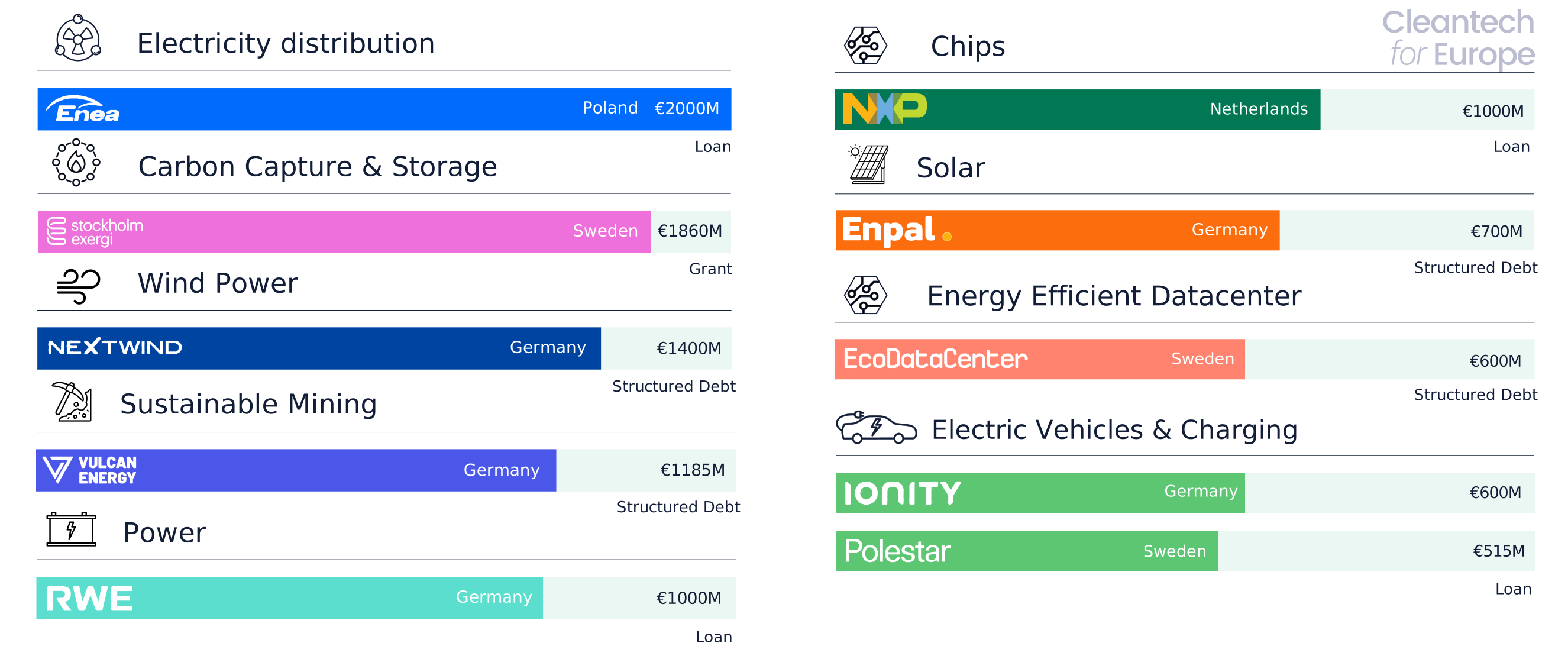
Scaling cleantech manufacturing and infrastructure requires large volumes of affordable debt financing, particularly at the capital-intensive commercialization stage where bankability is critical.
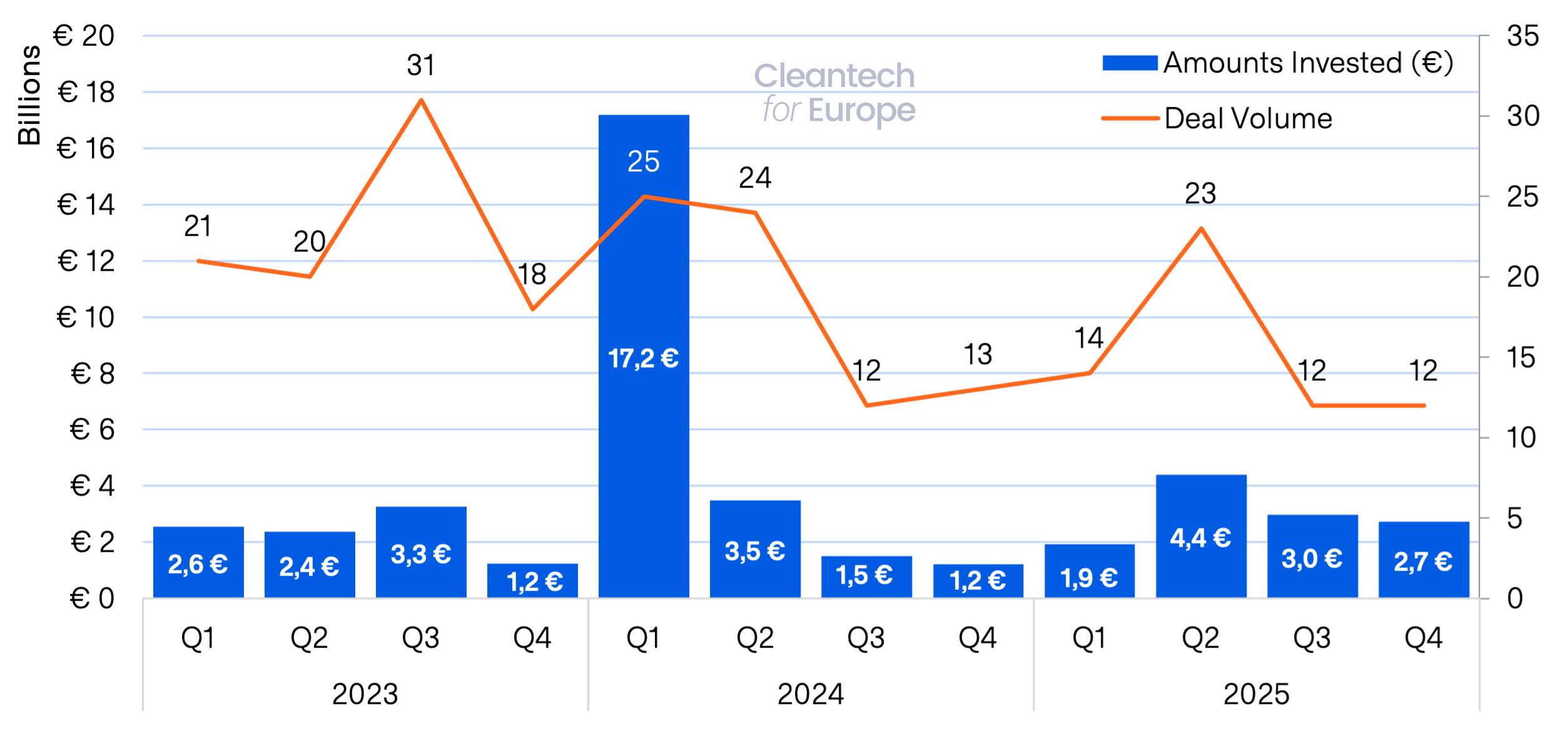
EU cleantech debt investment peaked in 2024 at €23.4bn across 74 deals, driven by a record-breaking Q1 (€17.2bn, 25 deals), reflecting a handful of mega-deals and strong public-sector participation.
In 2025, debt investment normalised to €12bn across 61 deals, with a more even quarterly distribution but lower overall volumes, underscoring continued challenges in securing late-stage debt at an affordable cost of capital.
Public lenders, including the European Investment Bank and national promotional banks, remain central to de-risking cleantech projects, crowding in private capital and enabling scale-ups to access debt financing.
Expanding access to debt and guarantees remains essential for EU cleantech competitiveness. Instruments such as the EIB’s €250m counter-guarantee facility for cleantech manufacturing represent an important step toward closing Europe’s debt financing gap.
EU27 Cleantech Debt Investment, 2023 – 2025
Note: Data includes loans, loan guarantees and structured debt, as well as project finance.

Project finance refers to long-term financing specifically tailored for standalone projects (e.g., renewable energy plants), where repayment primarily depends on the cash flow generated by the project itself, with limited recourse to the project sponsor. This is a common structure for large-scale infrastructure and energy investments.

Debt financing encompasses a broader range of financing instruments (e.g., loans, loan guarantees, structured debt), often used by companies for general operational needs or growth investments, and is secured against the company’s assets or creditworthiness rather than a specific project.

INVESTORS news

€2.05b

In January, Paris-based Omnes has reached the final close of Capenergie 5 at €2.05 billion, surpassing its €1.65 billion hard cap and marking its largest fundraising to date. The fund will provide growth capital to European renewable energy developers, supporting their transition into independent power producers. With nearly 100% re-up from existing investors, Capenergie brings Omnes’ renewable energy AUM to €4.3 billion.

€500m

In June, Milan-based Ambienta has secured €500 million for its new small-cap private equity strategy. The fund will back established European small-cap companies benefiting from environmental sustainability trends, leveraging Ambienta’s science-based investment approach and proprietary impact tools. Deployment will be pan-European, led initially from Milan and Paris.

€500m

In February, Amsterdam-based Polestar Capital launched the Polestar Capital emobility & infrastructure fund (PCEIF), a €500 million debt fund designed to finance the transition to zero-emission mobility. The fund will provide loans to emobility and logistics projects that struggle to secure financing elsewhere.

€250m

In August, Achmea Investment Management launched its "Healthy People & Planet 2025" private equity fund, securing €225 million at first close, targeting €250 million. Focused on climate, biodiversity, nutrition, and health, the fund targets market-rate returns and measurable impact, with first investments expected in Q4 2025.

€250m

In May, German fund Bosch Ventures, the corporate venture arm of Bosch, launched a new €250 million fund to support deep-tech startups worldwide, especially in electrification and cleantech. Since its founding in 2007, Bosch Ventures has made over 100 investments globally, reinforcing its role as a key partner in co-innovation and market-transforming technologies.

€235m

In November, Germany-based VC Future Energy Ventures Fund II closed in December 2025 at €235M. Backed by global partners, FEV invests in Series A and B startups delivering AI-driven, software-based solutions for grid efficiency, demand flexibility, and decarbonisation, accelerating Europe’s transition to an independent, resilient energy future.

02

Year in review: EU cleantech initiatives in 2025

Critical parts of the Fit for 55 package; the series of legislative proposals aiming at reducing the EU’s net emissions by at least 55% by 2030, are being finalised

Year in review: EU cleantech policy in 2025

CID

Faced with high energy costs and fierce global competition, European industries need urgent support. The Clean Industrial Deal was in February to turn decarbonisation into a driver of growth for European industries. This includes lowering energy prices, creating quality jobs and the right conditions for companies to thrive. The Deal presented measures to boost every stage of production, with a focus on  energy-intensive industries that urgently need support to decarbonise and the clean-tech sector which is at the heart of future competitiveness and necessary for industrial transformation, circularity, and decarbonisation. Cleantech for Europe was at the center of the debate pushing for an ambitious agenda and a boost on the demand for clean products.

EIB Guarantees

On June 20, 2025, the European Investment Bank approved a new suite of cleantech guarantee instruments under its TechEU program, notably the CleantechEU Guarantee Scheme. The facility provides €250 million in counter-guarantees to commercial banks, easing collateral requirements for cleantech scale-ups and freeing up working capital for manufacturing scale-up. Additional instruments include a €500 million PPA counter-guarantee pilot and €3 billion in guarantees for grid and wind manufacturing.
The €2.5 billion increase of InvestEU in 2025 sends a positive signal for scaling such de-risking tools – one that will need to be confirmed in the next Multiannual Financial Framework.

Scaleup Europe Fund

In October 2025, the European Commission announced the creation of the Scaleup Europe Fund, a new market-driven vehicle designed to address Europe’s late-stage equity gap in deep tech, including cleantech.
Backed by the Commission, the EIB and major institutional investors, the €5 billion fund, expected to launch in April 2026, will target large €100-150 million rounds through privately managed, sector-specialised sub-funds.
By crowding in private capital and focusing on de-risking rather than crowding out investors, the initiative aims to keep Europe’s next generation of industrial and clean technology champions scaling and manufacturing in Europe.

CISAF

On June 25, 2025, the European Commission unveiled the Clean Industrial State Aid Framework (CISAF), expanding Member States’ ability to support cleantech manufacturing amid intensifying global competition. CISAF facilitates the use of loans and guarantees, enables co-financing of Innovation Fund projects and “near-misses,” and introduces greater flexibility for capital-intensive technologies such as long-duration energy storage. By shifting aid ceilings from company to project level and strengthening blended finance and equity support for scale-ups, the framework better reflects cleantech investment needs.
However, the absence of production-based incentives, unlike the US IRA, remains a notable gap as EU budget discussions gain importance.

RESOURCEEU

On 3 December, the European Commission set out a more proactive economic security doctrine, prioritising reduced strategic dependencies and greater resilience, even at higher economic cost. ResourceEU, its first flagship initiative, targets Europe’s reliance on foreign critical raw materials through joint purchasing, stockpiling, recycling and €3 billion in funding, backed by the EIB and a new Critical Raw Materials Centre by 2026.

However, key challenges remain unresolved: public opposition to mining, exposure to price manipulation and volatility, skills shortages, weak regional integration, and uncertain long-term political commitment, putting effective delivery at risk.

EU-US Trade deal

In July 2025, the EU and the US agreed on a trade deal setting 15% tariffs on a wide range of European goods, alongside EU commitments to purchase significant volumes of US Liquified Natural Gas. The agreement raised concerns about Europe’s long-term competitiveness and energy dependence.
In response to renewed US pressure including President Trump’s demand to take over Greenland, the European Parliament suspended approval of the deal.
Amid an increasingly power-based, rather than rules-based, global trading system, Europe faces a choice: adapt or risk deeper dependency. Lead or be led. In our Scale or Fail trade report, we set out a concrete strategy to boost European competitiveness and resilience in this new global reality.

Year in review: EU cleantech policy in 2025

CLEANTECH FOR EUROPE SUMMIT

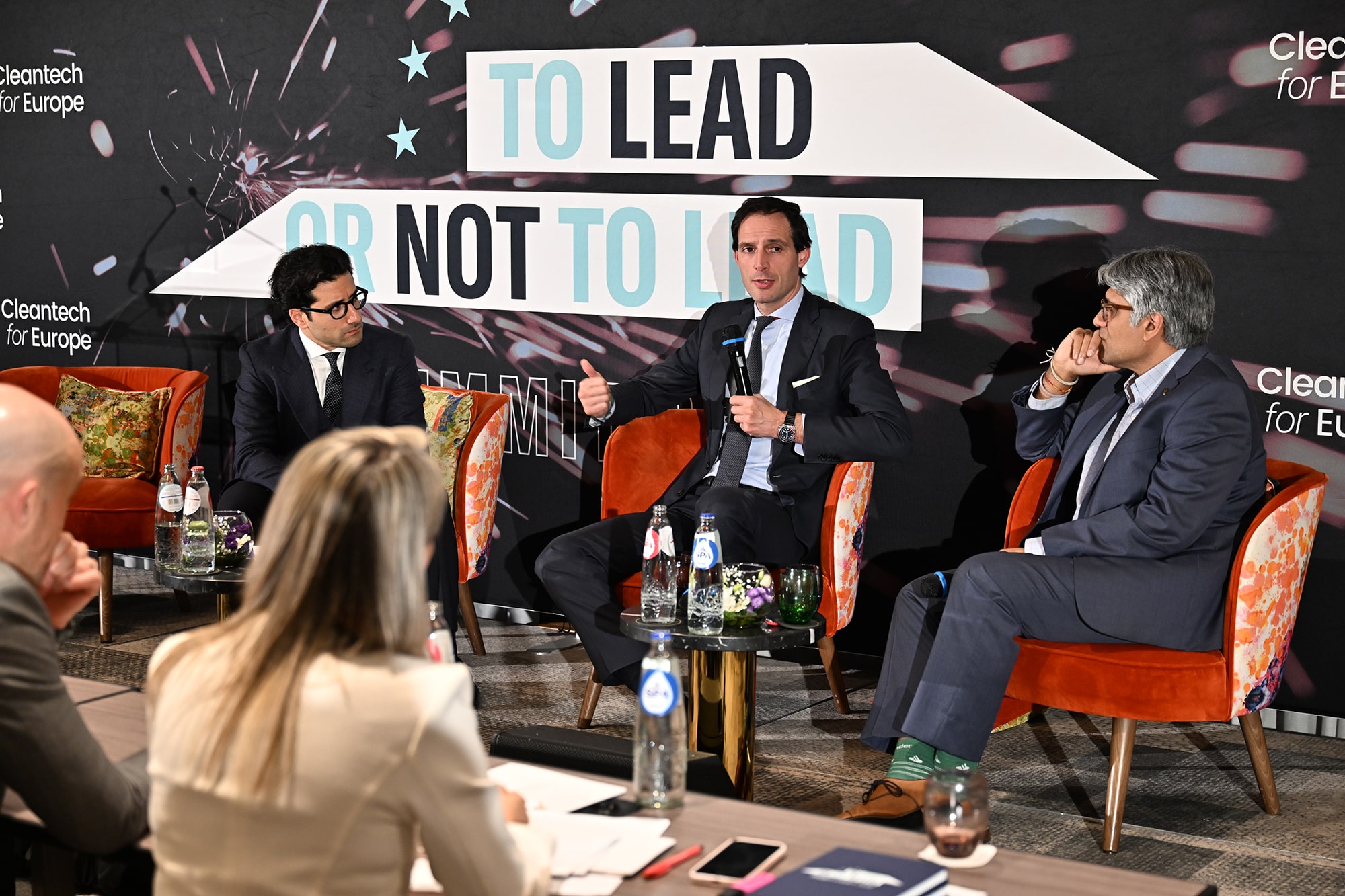
On December 3, 2025, the fifth Cleantech for Europe Summit took place in Brussels, bringing together senior policymakers, investors and industry leaders to assess whether Europe is ready to lead the global cleantech race. Executive Vice-President Teresa Ribera and Commissioner Wopke Hoekstra underlined the central role of cleantech manufacturing for Europe’s competitiveness, security and decarbonisation. The Summit also marked the expansion of Cleantech for Europe’s Scale-up and Investor Coalitions with nine new members: CorPowerOcean, GADrilling, GravitHy, Ingrid, LeydenJar, Newheat, PT1, Submer and Vianode – reinforcing a growing community of companies building Europe’s next generation of clean industry.

CLEANTECH FOR IBERIA

Cleantech for Iberia is playing a leading role in positioning Spain at the forefront of the clean industrial transition, as the country officially joins the World Economic Forum’s First Movers Coalition. Announced in Madrid with the Prime Minister and key ministers, the milestone reflects the growing influence of the Iberian cleantech ecosystem. Representing this community, Bianca Dragomir emphasised the need to scale solutions by activating demand and mobilising patient, catalytic and blended finance. Cleantech for Iberia stands at the centre of this effort, connecting innovators, investors, industry and policymakers to turn breakthrough technologies into clean industries, quality jobs and the factories of the future driving decarbonisation, competitiveness and energy security.

CLEANTECH FOR FRANCE

Cleantech for France is strengthening its position as a key player in France's green reindustrialization. Fourteen new members joined the coalition in 2025. Their membership was made official at the first Green Industries Summit organized by Cleantech for France in Bercy in January 2026, attended by the ministers of economy and industry. The event brought together numerous industrialists, investors, public decision-makers, and experts, and demonstrated the strength of the French cleantech ecosystem, whose influence continues to grow, as evidenced by France's fervent support for Made in Europe.

CLEANTECH FOR ITALY

In 2025, Cleantech for Italy marked a key milestone in strengthening Italy’s industrial competitiveness and energy security. In April, we officially presented our coalition, bringing together scaleups, investors, and ecosystem actors committed to positioning cleantech as a strategic pillar of national industrial policy. On that occasion, we launched the Cleantech for Italy Manifesto, outlining shared priorities and a concrete agenda to reinforce Italy’s role in Europe’s industrial future. This momentum culminated in June with our first Cleantech Summit, hosted at the Chamber of Deputies, where the broader cleantech community engaged with senior public and private stakeholders.

CLEANTECH FOR UK

In 2025, Cleantech for UK helped shape government understanding of the financing and deployment barriers facing clean technology companies seeking to scale, contributing evidence that supported the launch of the British Business Bank’s £4 billion Industrial Strategy Growth Capital initiative to strengthen scale up investment across the Industrial Strategy’s eight priority sectors, including clean energy. In parallel, we partnered with Innovate UK on research into first of a kind deployment challenges, working with industry and investors to identify practical solutions to accelerate commercial project delivery across the UK.

CLEANTECH FOR EUROPE

In 2025, the Cleantech Friendship Group (CFG), a cross-party forum in the European Parliament, was officially relaunched for the term, with the participation of European Commission President Ursula von der Leyen. The group brings together 35 MEPs from 15 Member States, working across political lines to help shape Europe’s Clean Industrial Deal and act as a key interlocutor with the Commission. CFG advocates for strong demand-side cleantech policies, including technology-specific targets, sustainable public procurement, fair competition measures and large-scale strategic investment. President von der Leyen highlighted the need to scale private investment in EU cleantech by orders of magnitude. Cleantech for Europe actively supports the activities of the CFG.

03

Deep dive:
Made in Europe

Critical parts of the Fit for 55 package; the series of legislative proposals aiming at reducing the EU’s net emissions by at least 55% by 2030, are being finalised

04

What the future holds

Deep dive: MAde in europe

Made in Europe — Creating real markets for European Cleantech

The European Commission is preparing the Industrial Accelerator Act (IAA), a cornerstone of the EU’s renewed industrial strategy and a key complement to the Clean Industrial Deal and the Competitiveness Compass. Initially expected earlier, the proposal has been delayed several times and is now provisionally scheduled for 25 February, reflecting both its political sensitivity and the ambition of the file.
The IAA is expected to build on and partially amend the Net-Zero Industry Act, notably by strengthening market creation instruments such as public procurement, auctions, and access to public funding. At the core of the debate is whether the EU should introduce explicit “Made in Europe” or local content requirements for strategic clean technologies, at a time when the US and China already tightly link public support to domestic production, and the geographical scope of the criteria.
While concerns remain around cost impacts, WTO compatibility, and internal market fragmentation, the Commission is exploring a phased and flexible approach, with safeguards to avoid supply shortages and excessive short-term inflation.

Cleantech for Europe priorities

Cleantech for Europe published in November a paper to call for strong Made in Europe criteria. The IAA is a critical opportunity to move beyond fragmented sustainability and resilience criteria toward clear, credible demand signals for clean technologies made in Europe. In a context of limited public budgets, demand-side tools are essential to unlock private capital and enable European cleantech companies to scale.
Sustainability and resilience criteria alone are insufficient: they remain complex, unevenly applied, and can be waived on cost grounds, resulting in weak and ambiguous signals for investors. Together with 115 stakeholders from the cleantech ecosystem, we called for the explicit possibility of European preference for technologies and value chains deemed strategic, applied in a targeted and proportionate manner in line with the Draghi framework.
“Made in Europe” must be predictable, gradual, and enforceable. Local content requirements should be phased in transparently between 2026 and 2030, aligned across EU and national funding instruments, and complemented by EU-level FDI screening and joint-venture rules to ensure real technology transfer and long-term industrial value creation in Europe.

04

What to look out for in 2026

Critical parts of the Fit for 55 package; the series of legislative proposals aiming at reducing the EU’s net emissions by at least 55% by 2030, are being finalised

What to look out for in 2026

Industrial Accelerator Act

Originally expected in January, the publication of the Industrial Accelerator Act was postponed to February 2025.
Ahead of its release, more than 100 cleantech companies, investors and industrial players issued an open letter urging the Commission to anchor the IAA in strong “Made in Europe” demand criteria. The message was clear: in a global context where public spending is increasingly tied to domestic production, EU funds must create predictable demand for European cleantech. The IAA is seen as a pivotal instrument to unlock private capital, support industrial scale-up and strengthen Europe’s competitiveness, resilience and strategic autonomy.

European Competitiveness Fund

In July 2025, the European Commission presented its proposal for the 2028-2034 EU budget, with negotiations in the Council expected to converge by June.
The debate comes at a critical moment for Europe’s clean industrial agenda, as constrained public budgets must support both industrial decarbonisation and the scaling of strategic cleantech value chains.
The MFF is increasingly framed as the financial backbone of an integrated EU cleantech industrial strategy - prioritising guarantees and de-risking tools, ensuring coherence across instruments such as the European Competitiveness Fund, InvestEU and the Innovation Fund, and anchoring spending in “Made in Europe” value chains to mobilise private capital at scale.

Grid Package

In December 2025, the European Commission presented its proposal for a Grids Package which aims to ease bottlenecks and build a more interconnected electricity and hydrogen network through stronger EU-level planning, faster permitting, investment mobilisation, and enhanced security. It introduces cross-border coordination, priority “energy highways” and measures to accelerate projects and attract private capital. However, timelines remain slow, two years for a central planning scenario, and the Package lacks clear support for European manufacturing of grid technologies, raising concerns over execution speed, industrial capacity, and strategic autonomy.

Emissions Trading System

In 2026, the EU will launch a comprehensive review of the EU Emissions Trading System (ETS) following the adoption of the 2040 climate target.
As the cornerstone of EU climate policy, the ETS review represents a pivotal moment. There is a risk that pressure from legacy industries could weaken price signals through extended free allocation or diluted market rules.
Conversely, the review offers an opportunity to reinforce the ETS as a credible investment and industrial transition tool, by ensuring predictable carbon pricing and better deploying revenues to support clean industrial scale-up, competitiveness, and resilience across Europe.

Public Procurement Review

The European Commission closed its public consultation on revising the EU public procurement directives on 26 January, with legislative proposal expected in Q2 2026. The reform aims to modernise and simplify rules while using procurement as a strategic tool, including the possible introduction of “Made in Europe” preferences to secure critical supply chains. The review acknowledges persistent shortcomings of the 2014 framework: legal complexity, limited cross-border participation, weak governance, and uneven strategic impact.
As the Commission seeks to create European lead markets, the inclusion of EU preference criteria in the IAA will be decisive for aligning public spending with economic security and industrial policy goals.

Electrification Plan

Foreseen for early 2026, the Electrification Action Plan (EAP) will seek to accelerate electrification across industry, transport and buildings and raise electricity’s share of final energy demand to 32% by 2030.
To deliver, the EAP must prioritise affordable electrification by closing the electricity–fossil price gap through energy taxation reform and better access to long-term clean power purchase agreements (PPAs).
Grid access and flexibility must be central, with faster connections, tariffs that reward flexible consumption, proper remuneration for non-fossil flexibility, and an EU-level flexibility target. The EAP should also support industrial heat electrification
Download the printable version
Policy Voices
Policy Voices
Scale-up Coalition
Scale-up Coalition
Industrial Decarbonisation
EU Funding
EU Funding
Regional Initiatives
Company News
Company News
In the Press
In the Press
Voices of Innovation
Cleantech Investors
Cleantech Investors
Policy Voices
Policy Voices
Scale-up Coalition
Scale-up Coalition
Industrial Decarbonisation
EU Funding
EU Funding
Regional Initiatives
Company News
Company News
In the Press
In the Press
Voices of Innovation
Cleantech Investors
Cleantech Investors