JULES
0’ - One year into a new political mandate, the European Union stands at a crossroads. With war still raging in Ukraine, a global trade war kicking off, and economic stagnation, the EU looks smaller than the sum of its 27 parts. Plagued by high energy costs, fragmented markets and Chinese overcapacity, European industry seems locked in a downward spiral, unable to invest in its own future.
Yet at the same time, Europe has a once-in-a-generation opportunity to seize. Large investors are looking to diversify away from the US. Political support for the rise of clean industry has never been higher. And world-class cleantech innovators are bringing revolutionary solutions to market - despite limited funding, lengthy bureaucracy and unfair competition from outside the EU.
So, the question for Europe today is: will we lean in and lead, with all the challenges that come with it, or risk being led?
I'm Jules Besnainou, and you're listening to Time to Scale, a podcast by Cleantech for Europe.
JULES
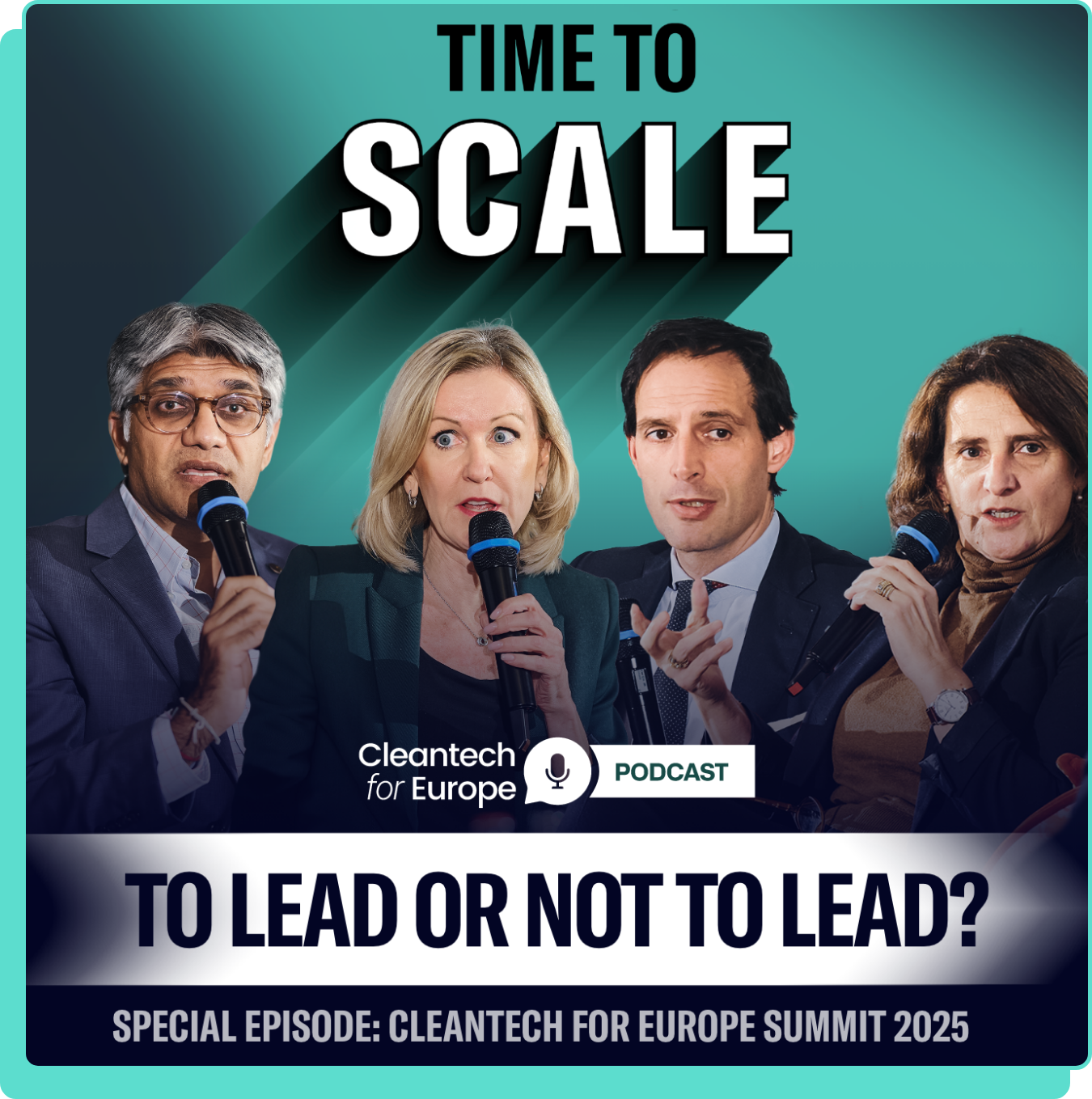
01’01 - Today, we have a bit of a special episode for you, to mark the end of the year. Earlier this month, we brought together political and cleantech leaders for Cleantech for Europe Summit, our annual gathering in Brussels. In this episode, we’ll bring you some of the hottest takes from the Summit, with guests such as EVP Teresa Ribera, Commissioner Wopke Hoekstra or US cleantech pioneer Jigar Shah, so stay tuned.
We named this year’s Summit: to lead or not to lead, reflecting a stark choice Europe has to make, to lead in clean industries or risk being led.
And this is not as obvious a choice as it may seem. Leading requires making hard choices, focusing on a few areas and being the best at it, it requires sacrifice and change, all things that Europe is not the best at.
But not leading also has terrible economic, social and political cost.
James Gutman from the Carlyle Group, co-author of the New Joule Order, lays the stakes quite starkly.
JAMES GUTMAN
02’05 - “We’re facing two existential dilemmas. As I was walking here this morning, our friendly neighbour to the East is reminding us that he’s just very happy to go to war with us. We are at war. I mean, I don't know how much more transparent it could be. That is our first existential crisis. The second existential crisis is climate change and it is very real but is also over the the horizon a little bit and we can solve both of them by reducing our energy dependence. Reducing our energy dependence means not importing oil and gas. Not importing oil and gas or reducing that means reducing our carbon emissions. That's how we get there and that's why we get there.”
JULES
02’50 - “So, Europe is facing this generational challenge of transitioning away from an energy system based on fossil fuels, not just for decarbonisation, but for our security and resilience. The good news is that cleantech can play an important part in solving this puzzle, and European Commissioner for Climate, Net Zero and Clean Growth Wopke Hoekstra recognises that very clearly.”
WOPKE HOEKSTRA
03’10 - “This whole transition that we’re currently facing is in my view about a combination of three things: climate, competitiveness and independence. Climate, competitiveness, independence. And if you are ever gonna wonder what is the mantra that I’m going to repeat the most in the next four years, it is exactly that. So, and why am I so hugely impressed by what you guys are doing and why do I need more of you? It’s actually because on each of the three elements, you play a pivotal role. We need more climate emissions. Why is that? Well, very simple: because the problem is going to mushroom into something that is even larger than it is today. Forget about everyone who's just talking about altruism and the planet. This is just a harsh economic reality in terms of the damage that we're currently incurring particularly in Europe because Europe is heating up twice as quickly as the rest of the globe. So, we're talking about tens and tens and tens of billions of euros per year and the number is only going to go up. Competitiveness, I don't need to explain it to you. Let's make sure we're not just the winners of yesterday, we're going to be the winners of tomorrow. And third, independence. If you want to build a new system, if you want to be more independent, you cannot just stay with the logic of today, right? You do need to make sure you have way more cleantech, you have way more investments in the in the grid, you have way more battery capacity, you have way more interconnectors in the European electricity system because frankly, it's not one market. It is 27 markets and on and on and on. So the good news is this is going to stay with us for a very long time and certainly for the for the next four years of this Commission and I will do my utmost to push this topic like there's no tomorrow.”
JULES
05’09 - “So, why are clean technologies so valuable in solving these challenges? The reason for that is quite simple: Europe, as a continent, is energy poor. So to find alternative solutions to imported fossil fuels, innovation is key. And this is why we need political support to clean innovation, as explained by MEP Lídia Pereira, Vice-chair of the European People’s Party.”
LÍDIA PEREIRA
05’32 - “And here we are pushing for something that is so relevant and so important as clean technologies in Europe for the reasons that we already explained: we don’t have resources in the continent, we need to innovate and to find alternative ways of energy.”
JULES
05’49 - “And indeed over the last 15 years, Europe has established itself as a true powerhouse of innovation. However, so far it has failed to turn this innovation strength into commercial success, which often leads to European companies looking into other markets. Here is US cleantech pioneer Jigar Shah on this challenge.”
JIGAR SHAH
06’11 - “The EU has done such an extraordinary job of innovation and has done so for decades, but even specifically in the 2017 to 2023 time frame where you have huge numbers of companies who have reached their technical milestones and now they are burning $2 million of cash per month in salaries etc. and you know they cannot wait for the solution right. So ultimately, if they don't feel like a solution is coming that meets their needs, they absolutely have to call their friends in Canada to say, "Can you help me?"”
JULES
06’50 - “So, how do we ensure that Europe turns its innovation engine into industrial success? One crucial ingredient is capital to fund the scaleup of innovative companies. Let’s listen first to Agate Freimane, General Partner at Norrsken Venture Capital.”
AGATE FREIMANE
07’04 - “I don’t think we have a lack of innovation. I also think that our capital markets have matured to a place where early-stage companies are getting the funding that they need and every now and then you’re still going to hear we don’t have enough capital in the early stages or not enough innovation is being funded. I’m a bit contrarian in a way that I disagree and I also would, as cynical as it sounds, not every innovation deserves to be funded and from what I can see from my seat is that the innovations that really do deserve to be funded are getting funded. So I think as Europe we have sorted out the early stage. I see that the ecosystem is working but again, the elephant in the room, and I’m not saying anything new and that’s you know builds on what you were saying and builds on a lot of the earlier speakers today is that scale-up is a challenge. Scale-up truly truly is a challenge. If you look at in early stage 80% of the capital that’s funding early-stage companies comes from Europe and 20% comes from the US. In the scale-up stage, the best performing startups, 80% of the capital comes from the US and 20% comes from Europe.”
JULES
08’11 - “So how do we mobilise that scale-up capital? Jean-Christophe Laloux, Director General at the European Investment Bank, points to the shrinking size of public budgets, which forces us to look also into private capital and how investors there can be incentivised.”
JEAN-CHRISTOPHE LALOUX
08’33 - “I think for us participants to the cleantech community and more largely to the economic development of the European Union is going to be absolutely essential to remind our political decisionmakers that the use of the budget should not be shrunk as far as investment is concerned. And it’s going to be a very tough battle because you can feel that one coming with fiscal policies actually tightening. The first area where there's going to be cuts is on investments and that is going to come to bite us very nastily. So that's the first thing to say. The second one is indeed how do you then make best use of the public budget and the public money that you have. And on this I agree that de-risking has a role to play.”
JULES
09’21 - “So de-risking is key to mobilising private capital for cleantech investments. Public institutions and politicians have several policy tools at hand for this kind of de-risking, as mapped out by MEP Pascal Canfin.”
PASCAL CANFIN
09’30 - “I think that there would be huge leverage if we manage to de-risk institutional savings going to the cleantech financing through just regular private tools, not only through EIB financing or CDC in France financing. So that’s why it’s, I would say, a new way to approach things. It is partly covered already by the new European Competitiveness Fund that will hopefully be kept to the very end of the MFF discussion but it’s for the next, it’s from 2028. So I mean we need to start now and that’s why I think that we should look at all the derisking approach in all the tools today not only waiting for the next MFF. And the Scale-Up Fund from the Commission is a step in the right direction, we have other tools that are being designed now with a more de-risking mindset which I think again is a good step in the right direction.”
JULES
10’53 - “Beyond public de-risking, a critical factor to attract private capital is showing clear demand for clean technologies. Burkhard Straube, CEO of Vianode, a synthetic graphite manufacturer from Norway, pointed to this.”
BURKHARD STRAUBE
11’09 - “Today we talked a lot about subsidies, subsidizing the industry, subsidizing the build up of the industry of capacities of scaleup. But that’s not sufficient. The demand side is just as important. We need to create demand in Europe. That will enable the industry to get offtake agreements. If we get offtake agreements, we get capital. We get funding. If we get funding, we can scale. And if we can scale, we can build, at least in the Western world, leading companies being competitive. And I think that’s what it has to be in the end, competitiveness.”
JULES
11’45 - “Now from our perspective, one of the bedrocks of demand for clean technologies in Europe is carbon pricing, also known as the Emissions Trading System or ETS, because large industrials are incentivised to adopt clean technologies when they start to pay a carbon price. I asked Executive Vice-President for a Clean, Just and Competitive Transition Teresa Ribera and Commissioner Wopke Hoekstra about their thoughts on the next few months, as the ETS is set to be reviewed next year.”
TERESA RIBERA
12’18 - “I think that it is quite clear that it remains in place. It is important to stick to this conviction on decarbonizing the economy as a great source of opportunities from an industrial perspective, innovation perspective, but also setting a standard that could be quite appreciated elsewhere. So I think that it is very obvious that this is a very relevant instrument to achieve these very same goals.”
JULES
12’41 - “And here’s Commissioner Wopke Hoekstra’s view on this topic of carbon pricing.”
WOPKE HOEKSTRA
12’45 - “So personally I think there are a couple of of things we need to do. One is indeed that if you zoom out that the most effective thing we have done not only to create clean tech at scale but also to to make sure that we're dealing with the climate problem is this market-based system called carbon pricing. And what is always what is always striking is that friends from outside are increasingly uh banking on this as well. They're doing the same. I was at the COP two weeks ago and that's it's hugely complicated. But one of the common denominators is that at least in some shape or form the Mexicans, our friends from Chile, from Brazil itself, the Chinese, Quebec and Canada, California in the US, the UK with a link to the ETS and a range of others are actually doing this or are about to do this because it works. And that is also why if I were an investor, I would bet on what you guys and girls are doing because the trend is going to, it's, I don't know exactly whether the trend is going to be quick enough from a climate perspective. I would like to see more speed, but I do know that this trend is going to continue at scale even with some of the hiccups we're having. Do yes, we're going to we're going to futureproof that even further. We are certainly going to make changes and improvements to the design also in Europe which again will be to the benefit of those in in your domain. But the bigger thing that is happening is that this truly is as the saying goes an idea for which the time has come and that makes it so powerful.”
JULES
14’28 - “Demand and funding are two sides of the same coin. And trade policy can have an impact on both. Nicolas Piau from TiLT Capital, a French investment firm focused on the energy transition, looks at the example of China for how they combined an industrial strategy for cleantech demand creation with elements of trade policy.”
NICOLAS PIAU
14’54 - “As an investor, the most important thing is okay we know that in 10, 15 years basically the direction will be this one. If the direction starts to be that one, oh why would be investing, what would be investing here? So that’s the first thing. The second most important thing in our perspective is to do that you need to recognize, to look at the world as it is and not as you think it would be. Yes, I would love a completely free open world market. Whatever, it has not been the case for ages and Europe has always tried to portray itself as, you know, the champion of free markets etc. The reality is China has started its made in China policy in 1995, saying that 40% of windmills had to be made in China in 1995. Who was speaking, who was speaking of wind energy in 1995 here? A very limited number of people. So that shows this sort of sense of direction, sense of long-term vision etc.”
JULES
16’06 - “Now, a similar idea of Made in Europe is being negotiated in Brussels, in the context of the Commission’s Clean Industrial Deal. But this would require Europeans to rethink their long-standing economic doctrines, and to protect nascent technologies from unfair competition. Let’s hear from Ann Mettler, former Director-General at the European Commission and now Distinguished Visiting Fellow at Center on Global Energy Policy at Columbia University.”
ANN METTLER
16’39 - “The way we have thought about economics is we bought cheap natural gas, cheap stuff from China. I’m sorry, this is not cheap. This is extraordinarily expensive in the long run. So we need more sophisticated economic models also in our public procurement. This is a matter of urgency. We need to rethink trade and competition policy. I don’t understand why our markets are so wide open with a country we have no trade agreement with and that doesn’t reciprocate that openness. It makes no sense. Made in Europe is coming up in the Industrial Accelerator Act. I want to start buying European stuff. I don’t want to use our purchasing power to prop up autocracies. Let’s have confidence in our companies. Have confidence in our entrepreneurs. Let’s buy their stuff. Let’s make sure that we give them a chance to scale.”
JULES
17’41 - “So, how do we achieve this European production at scale? The Industrial Accelerator Act, which has now been delayed to January 2026, promises to be a key legislative proposal to strengthen Europe’s clean industry. We were joined at our Summit by Aleksandra Kordecka, part of Cabinet Séjourné at the European Commission, who is working closely on this text.”
ALEKSANDRA KORDECKA
18’05 - “The point about made in Europe is I think like we’ve heard is public money for public industry, for European industry and European jobs and it’s absolutely not about closing the market completely. It’s not about autarky. It’s about creating the environment for European industry which has to compete with massive Chinese overcapacities. I mean we’ve just heard that. This is, it’s not a level playing field. We need to be addressing this. The other dimension of Chinese policies up until now were the foreign direct investment conditionalities where European companies investing in China were required to do tech transfer and that tech transfer has happened and now we have global competition. So one of the instruments we're looking at in the in the Industrial Accelerator Act is indeed reversing that and making sure that those companies with tech edge coming to invest in Europe would have to share tech transfer. Some other companies would have to have conditions like local employment or local sourcing to really make sure that we leverage the single market that is such a big asset of the EU and perhaps we're not leveraging it enough internationally. Cybersecurity is another dimension we're looking at. I think, you know, we've talked about it, the solar invertors being switched off. Just you know the security of our grids and our general energy systems depending on products from China that can be steered remotely. It's not just competitiveness issue. It's a security issue. So this is absolutely something that we would need to be looking at and making sure we're not naive.”
JULES
19’48 - “Now MEP Christian Ehler debated this point and presented some of the downsides of a Made in Europe policy.”
CHRISTIAN EHLER
19’54 - “So in a way I think yes, in terms of industrial policy, I mean we should link a little bit smarter technology investments, public procurement, as I said the framework conditions the permitting takes much too long, I think what we have to look to market gaps, but the principal question in Europe is from my point of view the capital market that is really a challenge for companies. I think all de-risking instruments for first movers that's all okay but the European Union picking the winners in technology races, I mean just forget it, the public sector is simply not able to do, we don't have public servants who would have the knowledge because if they would have the knowledge, they wouldn't work for the public sector. So brutally said so in a way I'm, I see that that we have to concentrate investments but I would say it is really the framing. Do we have a deepening of the European market? Do we have grit? Do we have a strategy to import industry? Do we really, are we able to deregulate and I say that brutally, it's deregulation in some terms because we might not achieve all at the same time CO2 reduction, sustainability and competitiveness. And that means we have to make compromises on some things. So in a way, I say that openly, I'm here for almost 30 years and I mean perhaps it's my unfriendly day, but this wet French dreams of top-down industry policy never worked. There are few examples in the past like Airbus where we had imperfect markets. But this idea that we are now driving with a bulk of public money industrial policy or technology policy besides putting an emphasis on spending more on R&D, look to market gaps, enable the capital market, perhaps mobilize for the time being also raw materials funds and things like that, but mobilize private capital this is not going to work and it's an illusion to be honest.”
JULES
22’20 - “But many at the Summit cautioned against having a naive approach concerning China. Nils Aldag, CEO at Sunfire, a company that manufactures electrolysers for green hydrogen production, shared an anecdote that perfectly captured the Chinese approach to European companies and the European market.”
NILS ALDAG
22’36 - “I just wanted to tell you a quick story. I had a phone call with one of the largest Chinese companies that asked me to exchange thoughts on the hydrogen market. And I went into that call openly and wanted to listen and eventually they were trying to ask me if Sunfire could be used to bring Chinese technology to the European market. And I spoke with them and eventually I said, "Well, is is that a two-way street? Is there a way that I can also sell my products into China?”. And literally six people on the other line of the of the telephone conference immediately started to laugh and say, "No, no, sorry, you haven't understood this, right? This is a one-way street from our point of view." So, I think we need to acknowledge that and we need to be strong about that and fight for the industries that we have.”
JULES
23’26 - “So, on trade policy, European companies are facing unfair competition from abroad and that trade measures are needed to even that out. Joseph Dellatte, an expert in Asian industrial policy from French think thank Institut Montaigne, argues that instead of speaking of a trade imbalance here, Europe needs to acknowledge its structural dependency on China.”
JOSEPH DELLATTE
23’49 - “So let’s name the elephant clearly in the room. This is not cyclical trade imbalance where that we are dealing with. It’s a structural industrial dependency problem and this is where other Northeast Asian nations, where their situation is quite instructive because they face the Chinese reality much more closely than us and they never belied the illusion that interdependence alone would neutralize power. So what can they teach us? What Japan, Korea and others can teach us? Strategic sectors are never left to market alone. So in Japan, Korea and Taiwan, for instance, semiconductor, battery, display, power, electronics, hydrogen technologies are not just industries. They are increasingly seen as national security assets, particularly for energy security.”
JULES
24’44 - “This shift in narrative from cleantech as a mere climate and decarbonisation topic to the crucial role it can play in providing energy and economic security will be crucial in the months and years to come. Executive Vice-President of the European Commission Teresa Ribera pointed to this potential of clean technologies for Europe’s leadership and future.”
TERESA RIBERA
25’01 - “Clean technologies are now at the heart of Europe’s energy security, competitiveness, climate goals, geopolitical strength and leadership, possibilities to develop partnerships, possibilities to face threats and challenges. So securing reliable access to the technologies that will be shaping the global economy is absolutely key.”
JULES
25’30 - “With this, it’s now time to get to business. While Europe indeed faces numerous challenges and finds itself at a critical juncture in its history, what we also wanted to share a message of hope. Political leaders see the enormous potential of the cleantech industry, and several of them expressed their strong commitment to keeping cleantech companies in Europe, for example Commissioner Wopke Hoekstra.”
WOPKE HOEKSTRA
25’54 - “The one thing I really want you to do because I think we're solving these problems. There is a hugely bright future for all of you here. It might not arrive today, but it will arrive. I promise you the moment you're honestly thinking about leaving, give me a call. Let's make sure we find 20 good reasons to stay.”
JULES
26’12 - “So Europe has many of the necessary ingredients to become a clean industrial leader: the challenge now is to strategically unite these and turn them into success on the ground. Although, as Julia Reinaud, Senior Director at Breakthrough Energy reminded us, in truth one key ingredient is still missing: execution.”
JULIA REINAUD
26’31 - “Enough diagnostics, now we execute. Don’t stop me now should be the motto. We have produced enough diagnostics and many of them were quoted today: the Draghi report, the Letta report, even our cleantech for reality checks. Enough studies, enough consultations. Although don’t get me wrong, I’m very much in favour of consultations. But we need to act. The missing ingredient is not insight, it’s execution. Execution on keeping the companies in Europe. Execution on spending that actually unlocks scale. Execution on an energy system capable of powering a modern industrial continent. Companies are ready. Investors are ready. Technologies are ready. Now Europe must be ready too. The next phase is not analysis. It’s delivery. Don’t stop me now.”
JULES
27’18 - “So how can we deliver that? Let’s listen one final time to our friend Jigar Shah from the US.”
JIGAR SHAH
27’26 - “I think Europe needs to stop telling itself what it can’t do. Right? Because it’s not frankly fun for me and it’s certainly not fun for you. I think it needs to start being confident about what it can do. I think that on the electric state right it can deploy a huge number of electric vehicles. It can fully integrate them. It is taking public a huge company right called Kraken that like is basically an orchestrator of a lot of the DERs and other things around Europe. Like they don't have a lot of contracts in the US, right? So those contracts are in Europe and so clearly Europe is doing a lot right and the question becomes is it going to see it all the way through. Are we going to actually continue to decarbonize the grid? I think we will. Are we going to continue to electrify everything? Maybe. Right? And so and we have a lot of good tools by which to do that. So let's get it done. Right? Let's continue to roll out all those things. If in the future Europe wants to manufacture here, there are tools that we can share with them around how the US has done it, how Canada has done it, how Australia has done it, etc. But if it doesn't want to do it, I mean, I think Ethiopia is good at what they do. So is Jordan, so is Turkey, so are India, so are others just procure from non-Chinese sources, right? And actually like just diversify your supply chain, right? Like I don't know that like Europe needs to like constantly be in the state of like you know we are not as good as other people or whatever it is. I think it needs to just start to lean into the stuff that it's extraordinary at and attract a huge amount of private sector capital in those areas and support all of these extraordinary entrepreneurs who are here who are ready to deploy at scale because the technology here is ready. It's ready to go. It's cheap. It's far cheaper than importing LNG at $14 a million BTU, right? And so now, let's get to it.”
JULES
29’19 - “So all in all, the Summit made it very clear to us: Europe is willing to lead in clean industry but now is the time for the hard work to begin. In the new year, we will use this podcast to showcase the business and political voices working towards this new leadership. Thank you for tuning in to Time to Scale, the podcast by Cleantech for Europe. If you enjoyed this episode, please subscribe, rate and review, share it with a friend, or send us your feedback and questions. For those who didn’t get enough yet, we’ll put the link to the whole recording of our Summit in the episode notes. Happy holidays and until next time!”